

Asking the right 15 questions to ask before choosing a makeup brush supplier directly impacts product quality and your brand’s profit margins. Poor selection leads to costly reworks, delayed launches, and customer complaints.
We evaluate a supplier’s production capacity, like monthly output of 100,000 fırçalar, and sample lead times, sıklıkla 7-15 günler. This guide ensures your choice supports scalable growth and consistent quality.
Why Asking the Right Questions Matters More Than Any Generic Checklist
Asking the right questions in makeup brush sourcing is a strategic tool, delivering better products and fewer problems than any generic checklist. It’s a hard control mechanism for quality and brand differentiation.
Checklists Limit Insight; Strategic Questions Unlock True Potential
Generic checklists often fall short in makeup brush sourcing. They treat all suppliers and projects the same, even though brush types, target markets, and quality expectations differ widely. This static approach limits true insight and can lead to problems.
- Checklists are static; projects are dynamic: A standard list (Adedi, price, lead time) ignores the unique aspects of different brush types, target markets, regulations, and quality expectations.
- Brands with good questions launch better products: Manufacturers confirm that brands asking the right questions early consistently launch superior products. This means fewer customer complaints and better reviews.
- Questions find hidden risks: Critical risks like hair blending methods, glue chemistry, or ferrule crimping processes usually do not appear on basic checklists. Buyers uncover them by asking detailed questions.
- Questions test competence and communication: How a supplier answers technical questions shows their engineering ability, documentation level, and collaboration skills. Poor communication early often predicts later production errors.
Strategic questions help you look beyond basic criteria like price or MOQ. They force suppliers to think about your brand, market, and use-case alignment. This ensures they propose solutions specific to your needs, not just generic stock items.
A Question-Driven Approach Delivers Superior Outcomes for Brands by 2026
A question-driven approach links directly to managing financial and operational risk. It helps uncover the total cost of ownership, manages launch timing, and builds strong partnerships.
- Hidden cost drivers: Strategic questions go beyond unit price to uncover actual cost structures, sampling fees, rework costs, and how quality issues are handled. This helps protect your margin.
- Launch timing and project management: Detailed timeline questions give you reliable schedule data, which is crucial for campaign planning and retailer onboarding. It helps avoid delays from underestimated complexity.
- Partnership scalability: Brands that ask about capacity and scale-up capabilities build long-term relationships. This reduces risk of quality drops when orders increase.
- Direct impact on performance: Asking the right questions upstream leads to brushes with better softness, pickup, payoff, and reduced shedding. It also improves ease of cleaning and overall application quality.
- Brand reputation: Customers experience brushes that match a brand’s claims and price point when designs, malzemeler, dayanıklılık, and quality control are questioned properly. This builds loyalty and better reviews.
Prioritizing systematic, context-specific questions is not a soft skill. It is a critical control mechanism for product quality, maliyet, and brand differentiation. It consistently delivers better outcomes than relying on any generic supplier checklist alone.
Questions About Manufacturing Capability
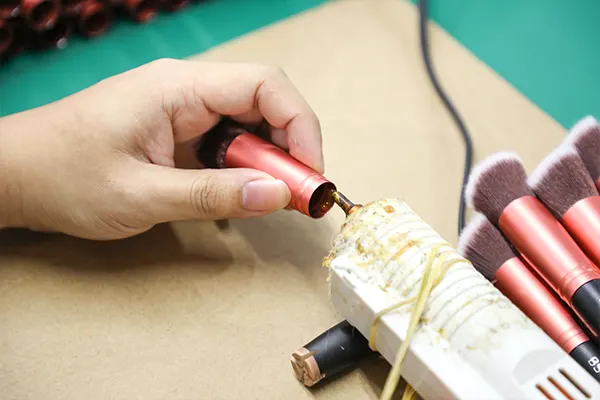
You need to know how a supplier makes brushes—in-house or outsourced. This directly impacts product quality, delivery, and consistency.
Q1 — Do you manufacture in-house or outsource any part of production?
- Manufacturing models in this industry:
- Fully in-house manufacturers own and run their own brush factories. They control most steps: handle shaping and finishing, ferrule forming and crimping, bristle bundling, assembly, and final inspection.
- OEM/ODM manufacturers often make core components in-house (especially bristle heads and assembly). They selectively outsource non-core or specialized steps, like metal ferrule stamping, laser engraving, or packaging, to vetted partners.
- Trading companies outsource nearly all production to third-party factories. They focus on sourcing, coordination, and export logistics, usually having limited direct control over manufacturing or quality systems.
- Why in-house vs. outsourced matters for buyers:
- In-house production generally gives you better process visibility, tighter quality control, and more stable lead times. The supplier manages its own workforce, machinery, and schedules.
- Mixed models (partial outsourcing) are common. Buyers should identify which parts are made internally, especially bristle forming and assembly, because these directly affect performance and consistency.
- Outsourcing non-critical elements (örneğin, standard aluminum ferrules, cartons, çanta) typically poses no risk. This holds true if the supplier documents incoming material inspection and has supplier qualification procedures in place.
- Actionable checks for buyers:
- Ask for a clear process map: which steps are done in-house, which are outsourced, and where each partner is located.
- Request evidence of factory ownership or long-term tenancy, production photos, and any quality certifications (örneğin, ISO, GMPC) tied to the production site.
- Verify if the supplier is a manufacturer versus a trading company. Ask about their equipment (ferrule stamping machines, automatic handle painting lines, bristle forming machines) and production staff size.
- Confirm how they manage outsourced components: incoming inspection, batch traceability, and corrective action with sub-suppliers.
Q2 — What is your monthly production capacity for fırça setleri?
Monthly capacity varies widely; your custom brush sets need specific, clear numbers to ensure timely delivery and future growth.
- Typical capacity ranges for professional makeup brush factories:
- Established OEM/ODM factories serving global brands often operate at tens of thousands to hundreds of thousands of brushes each month. This depends on automation level and product mix.
- Capacity is usually quoted separately for brush sets (kits) Ve single brushes. Sets require more complex coordination of handle finishes, ambalajlama, and assembly.
- For many private-label suppliers, MOQ for brush sets commonly starts at 500–1,000 sets per design. This aligns with factories that can comfortably scale to several thousand sets each month across many clients.
- How capacity is usually measured and communicated:
- Factories may state capacity as: number of sets per month (örneğin, 20,000 brush sets/month), distinguishing between basic sets versus premium, labor-intensive sets.
- They also might report total brush pieces per month (örneğin, 300,000 brushes/month), with a conversion factor based on average set size.
- Actual effective capacity depends on brush complexity (hand-shaped natural hair vs. standard synthetic bundles), custom finishes (multi-layer painting, metallized ferrules, special engraving), and packaging operations (gift boxes, inserts, çanta, labeling).
- Operational factors influencing monthly capacity:
- Workforce size and skill level: bristle forming, bundling, and assembly remain labor-intensive in many factories. Premium or artisan-level brushes need more skilled workers and reduce maximum volume.
- Otomasyon: automatic handle sanding and painting lines, automated ferrule cutting and crimping, and semi-automatic bundling machines increase throughput for standard designs.
- Seasonality: capacity utilization peaks before major retail seasons (örneğin, holiday collections). Available capacity for new orders can vary across the year.
- OEM load: factories that serve multiple large brands can be near their practical capacity. Lead time and scheduling flexibility become as important as raw capacity.
- Actionable questions for buyers:
- Request the supplier’s monthly capacity specifically for complete brush sets, not just individual brushes. Ask them to distinguish between standard synthetic consumer sets and high-end or professional sets that need more handwork.
- Ask for their average monthly output over the last 12 aylar. Ayrıca, ask for the maximum surge capacity (örneğin, for a large promotion).
- Confirm how they allocate capacity among clients: priority rules, booking windows, and how they handle urgent replenishment orders.
- Ensure their stated capacity comfortably covers your launch volumes plus replenishment, with buffer for growth.
Q3 — Can you show examples of OEM work done for other brands?
Past OEM work showcases a supplier’s real capability and design skill. Check examples that match your brand’s specific needs.
- OEM practice in makeup brush manufacturing:
- Most leading suppliers in this segment operate as OEM/ODM manufacturers. They produce brushes branded and packaged for other companies, from indie labels to mass and prestige brands.
- OEM work typically includes: custom handle shapes, malzemeler, and finishes; tailored ferrule designs and plating colors; custom fiber blends and head shapes tuned to specific formulas (örneğin, likit temel, pudra, krem); and full sets with coordinated aesthetics and packaging for retail or subscription boxes.
- Types of OEM evidence suppliers can provide:
- Portfolio photos of past brush sets and single brushes (without revealing confidential information like unreleased designs).
- Case examples describing brand type (indie, professional, mass, lüks), target market and price point, design challenges (örneğin, cruelty-free fibers with natural-hair performance, compact travel sets, color-critical branding), and outcome (lead time, quantities, and market feedback).
- Physical samples of previous OEM work that show different handle materials, ferrule finishes, and fiber technologies.
- Certificates or proof of working with over 100+ brands, or similar metrics, where disclosed.
- Confidentiality constraints:
- Many factories are under NDAs. They cannot disclose full brand names or exact design details for all clients, especially for high-profile or luxury brands.
- Yerine, they often anonymize brands (örneğin, “European prestige brand,” “US indie brand”) while still showing their craftsmanship and technical solutions.
- Actionable checks for buyers:
- Ask for OEM examples that match your segment. If you are niche luxury, ask specifically for work done for similar price points and aesthetic styles (minimal, editorial, artisanal, vesaire.). If your brand is cruelty-free, ask for examples with advanced synthetic fibers and vegan materials.
- Request a curated sample pack: one or two face brushes with different fibers and densities, eye blending and detail brushes showing control and finishing, and at least one full set showcasing handle–ferrule–bristle coordination.
- Confirm whether they support: custom logo application (silk screen, sıcak damgalama, laser engraving) and color matching to brand Pantone or similar systems for handles and ferrules.
- Ask how they document OEM projects (spec sheets, drawings, fiber codes) to ensure repeatability for reorders and seasonal variations.
Q4 — What materials can you source for handles, yüksükler, ve kıllar?
Material options define your brush’s quality and feel. Ask for detailed specs on handles, yüksükler, and fibers to align with your brand.
- Handle materials
- Common industrial options: Odun (typically birch, beech, or other hardwoods) for standard and premium ranges, with options for staining, painting, and lacquering. Plastik (ABS, PVC, vesaire.) for lightweight, cost-effective handles, allowing complex shapes, gradient colors, and integrated features (örneğin, caps, dual ends). Metal handles (alüminyum, alloy) in more specialized or premium designs for weight and a sleek aesthetic.
- Premium or specialty handle materials: FSC-certified or sustainably sourced woods for eco-positioned brands. Biodegradable or bio-based plastics for sustainability-focused lines. Custom materials for luxury: resin, akrilik, or composite handles with embedded particles, marbling, or translucence.
- Finishing options: Glossy, mat, yumuşak dokunuş, rubberized coatings. Screen-printed or hot-stamped logos and text. Gradient or multi-coat lacquers, metallic or pearl effects.
- Ferrule materials
- Standard ferrule materials: Alüminyum (most common for consumer and mid-range brushes) due to its good strength-to-weight ratio and cost-effectiveness. Copper or brass (more often in premium or professional-grade brushes) for enhanced durability and a higher-end feel.
- Surface treatments and finishes: Anodized, plated, or painted finishes in a wide color range (siyah, rose gold, gunmetal, chrome, colored metallics). Brushed, parlak, or satin textures to match brand aesthetics.
- Form factors: Standard round ferrules, flat ferrules for paddle brushes, crimped ferrules for dual-fiber or specific head shapes. Custom stamped shapes for signature collections (örneğin, faceted or sculpted ferrules).
- Bristle materials (fibers)
- Sentetik elyaflar (industry default for cruelty-free brands): Standard synthetic fibers (örneğin, PBT, naylon) widely used across face and eye brushes for powders, sıvılar, and creams. Next-generation synthetic fibers engineered to mimic natural hair’s cuticle and flexibility, improving pickup and release for powder products. Options for antimicrobial or treated fibers are available from some manufacturers for hygiene-focused ranges.
- Natural fibers (used where legally and ethically permitted, and when the brand is not strictly cruelty-free): Goat, midilli, or other animal hair for certain powder and blending brushes, primarily in traditional or professional lines. Natural fibers are often hand-shaped and may need more skilled labor and stricter sourcing controls.
- Selection based on product type and brand positioning: For cruelty-free brands, suppliers typically recommend premium synthetics with performance tuned for: yoğun, soft fibers for foundation and buffing brushes; iyi, flexible fibers for eye blending and detail work. Brands targeting professional artists may mix fiber types (within cruelty and regulatory limits) to optimize performance for specific textures and techniques.
- Actionable questions for buyers about materials:
- Ask for a material catalog listing: available woods and plastics, with associated finishes and colors for handles; ferrule metals and finish options, including plating thickness or treatment type; and synthetic fiber families, deniers, tip treatments, and any performance claims (örneğin, “powder-optimized,” “high pickup for liquids”).
- Confirm sourcing and compliance: whether wood is FSC or similar certified, if sustainability is part of your positioning; whether synthetic fibers and coatings meet applicable cosmetic-contact and chemical safety requirements.
- Request sample brushes using different material combinations to evaluate: weight and balance (halletmek + başlık); sensory feel of fibers on skin; and visual coherence between handle finish, ferrule color, and bristle tone relative to your brand identity.
These manufacturing capability questions cover in-house versus outsourced production, monthly brush set capacity, OEM track record, and materials sourcing. They are core filters for choosing a reliable makeup brush supplier. Bu taraftan, you support brand-specific design, verim, and scaling needs within the cosmetic brush industry.
Elevate Your Stock with Premium Beauty
Questions About Quality Control Process
Q5 — How do you ensure consistency between the sample and bulk production?
We use a sealed “golden sample” as the fixed benchmark for all bulk production. This sample is non-negotiable. A detailed specification sheet documents every technical detail: kıl tipi, dimensions, başlık, halletmek, glue, and defined tolerance ranges, like ±1 mm for key dimensions.
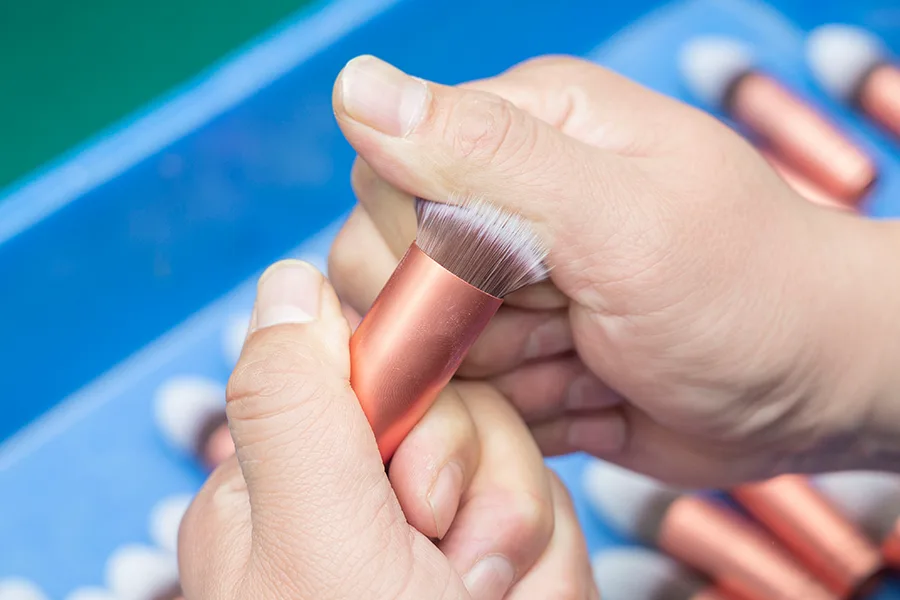
Raw materials for bulk runs must be identical to the approved sample. Incoming inspections and batch management ensure this consistency. Standard Operating Procedures (SOPs) lock down key process parameters for steps like hair transplantation, glue application, and coating. This prevents unauthorized changes. We use stage-gate QC checkpoints including pre-production, in-process (DUPRO), and final inspections. This helps detect deviations early. We also do measurement and performance testing, covering visual comparisons, dimensional checks, bristle shedding/pull-out tests, makeup application tests, and durability checks (örneğin, logo abrasion, handle-ferrule strength).
Q6 — What is your standard rejection rate and how are defects handled?
We categorize defects clearly: Critical (safety/regulatory), Major (functional failures), and Minor (cosmetic issues). Documented pass/fail standards define each. We use an AQL-based inspection system, which sets different acceptable quality levels for each defect category, targeting zero critical defects.
Defect detection happens through multi-stage inspections (incoming material, in-process, final visual) and lab tests, like bristle pull-out strength or logo abrasion. We have procedures for reworking or discarding defective units. We also conduct formal root cause analysis and implement corrective actions to prevent recurrence. This could involve SOP adjustments, retraining, or material spec changes.
Our policies address defects found by the customer. We offer replacement, credit notes, or rework agreements, and prioritize rapid corrective production for private-label brands.
Q7 — Do you conduct a final QC inspection before shipment?
Evet, final QC happens before shipment. This includes visual inspections of finished brushes for appearance, şekil, cleanliness, and functional checks. Örneğin, we manually pull bristles, check handle-ferrule stability, and test performance with makeup.
We also verify packaging and labeling to match specifications. This means checking pouch/box type, labels, logo quality, and carton packing details like unit counts and protective liners. Final QC uses an AQL-based sampling plan with defined sample sizes and clear accept/reject thresholds. Inspection results are recorded for traceability. This final QC is the last step after all earlier inspections and tests. If a lot fails, we block it from shipment until we complete rework and re-inspection.
Q8 — Can you provide a pre-shipment inspection report?
Evet, we provide pre-shipment inspection reports. These reports contain basic shipment information: customer, product, PO, batch numbers, miktar, and inspection details. They also detail the sampling and inspection methodology, including the AQL standard, sample size, defect criteria, and references to the golden sample and specification sheet.
A results summary presents the number of units inspected, defect counts by category (critical, major, minor), a final accept/reject judgment, and any rework actions. Detailed findings often include photos, measured dimensions compared to specs, test results (örneğin, bristle pull-out strength, logo abrasion), and notes on packaging. Reports may also include compliance statements (örneğin, internal QMS, environmental/chemical safety standards like REACH) and references to internal lab test records. We recommend you require standardized reports for each bulk order, access to underlying lab data, and an agreement that shipment will not proceed without your report approval.
Questions About MOQ, Örnekleme, and Timelines
Q12 — What is your MOQ for custom OEM orders, and is it flexible for first-time buyers?
Most factories set their MOQ for fully custom OEM makeup brushes or sets between 500–1,000 units per style or per set. Many established OEM factories advertise 500 units as a standard MOQ for custom brushes using existing molds, where you only customize the logo and colors. Some OEM/ODM suppliers position themselves with “düşük MOQ,” going down to 100 pieces per brush type for custom or private label orders. This usually applies when they use stock components and simple logo printing.
The MOQ for custom OEM orders generally depends on a few things:
- Level of Customization: Putting your logo on existing designs means the lowest MOQ, often 100–500 pieces per style. The handles, yüksükler, and heads are already tooled. You just customize printing and finishing. Custom colorways on existing molds often have the same MOQ as basic logo customization, etrafında 500 birimler, when the factory has existing finishing lines. They do not need special tooling. If you need new handle molds or unique head shapes, the MOQ goes up. The factory needs to cover mold and setup costs over more units, so manufacturers often push for 1,000+ pieces per style or set.
- Brush Type and Materials: Complex, multi-fiber, or mixed-material brushes typically have a higher MOQ than basic powder or eyeshadow brushes. Natural hair made-to-order, like goat, sincap, veya samur, also generally requires a higher MOQ than standard synthetic fibers, which factories always have in stock.
- Production Line Efficiency: Factories group orders by hair type, ferrule type, and handle coating. They need a minimum lot size to keep lines efficient. If buyers want lower quantities, they often must accept higher unit costs or limited customization.
MOQ flexibility for first-time buyers is often there. Many suppliers support pilot orders or trial orders for new brands, especially if your design uses existing molds and standard materials. Flexibility also increases if you accept a more limited SKU mix, Örneğin, just one hero brush or a small core set.
You see this flexibility in the market. An OEM factory might offer an MOQ “from 100 pieces per brush type” for custom or private label work. This clearly targets smaller or new brands. Manufacturers that support “pilot orders and large-scale retail rollouts” signal they will negotiate lower MOQs on initial orders, especially if they see growth potential.
Suppliers might keep their formal MOQ but agree to lower the initial quantity for a surcharge or a slightly higher unit price. They might also combine colors or minor variations within one MOQ. Örneğin, 500 total pieces split across two or three handle colors. They may accept a smaller number of SKUs, like 1–3 core brushes, instead of a full 10–20 piece set. This helps you stay within budget while still hitting the total unit MOQ.
Factories are more flexible when you show a clear branding and launch plan, indicate long-term reorder potential, and use standard finishes and stocked materials for the project.
Here are some checks to run with a potential supplier:
- Ask if they define MOQ per brush style, per set, or per entire order.
- Clarify whether you can mix different handle colors, logolar, or ferrule finishes within one MOQ lot.
- Confirm if they offer a different, lower MOQ for using existing stock shapes with only logo printing. Ayrıca, ask about private label (ready-made brushes plus your logo) versus fully custom OEM.
- For first-time buyers, specifically ask about pilot runs below standard MOQ. Also inquire about graduated MOQs, beğenmek 300 units for a first order and 500+ for reorders, and different MOQs for brush sets versus single brushes.
Q13 — What is your sample lead time and what is included in the sample fee?
For custom OEM brushes using existing molds, many manufacturers quote about 7–15 days from design confirmation to sample shipment. One OEM factory, Örneğin, ships physical samples within 7–10 business days after design confirmation. Simple color or logo samples on existing products, like custom color finishes, can be ready in 2–3 days in-house before full sample assembly. More complex custom development, like new shapes, special hair, or bespoke packaging, can extend sampling to 2–4 weeks. This happens especially when multiple revision rounds are necessary. Industry practice accounts for 2–3 sample iterations before final approval, with each iteration adding days or weeks to the overall sampling phase.
A few key steps drive sample timelines:
- Requirement Discussion & Briefing: This involves defining your target market, quality level, and budget. You decide on brush types, hair material, handle style, yüksük kaplama, ve paketleme. For experienced OEMs, this takes a few days once the brief is clear.
- Design and Technical Development: You create 3D design drafts, handle specifications, color references, and select materials. This typically takes a few days for experienced OEMs.
- Prototype / Sample Production: This is the core 7–15 day sampling window. It includes cutting hair to shape, assembling the ferrule and handle, applying coatings and logos, and curing finishes.
- Sample Adjustments and Second-Round Prototypes: After you test the sample for softness, yoğunluk, shedding, handle feel, balance, and logo accuracy, you request changes. The factory then makes adjusted samples, which repeats parts of the cycle.
- Packaging Sample Development: If you need custom boxes, pouches, or FBA-ready sets, packaging prototypes can run at the same time as brush sampling or add extra time. This usually takes several days to 2 haftalar, depending on complexity.
A typical sample fee includes several items:
- Brush Component and Assembly Costs: The fee covers the hair, başlık, halletmek, and labor used to build the prototype. Because samples are made in small quantities, the per-unit cost is higher than mass production.
- Customization and Development Work: 3D design drafting, engineering adjustments, and material sourcing are often part of the sample fee instead of being charged separately. For fully custom shapes, part of the engineering and R&D cost is covered through higher sample charges or higher MOQs later.
- Surface Finishing and Branding: Custom handle coating, color matching, logo baskısı (silk screen, sıcak damgalama, laser engraving), and any special ferrule finishes are normally in the prototype so you can see the final look.
- Basic Quality Control on Samples: Visual inspection for shedding, ferrule tightness, handle finish, and logo accuracy is standard before shipping any sample set.
- Sample Packaging: The sample fee might include a simple polybag or generic box for protection. It might also include one or a few units of custom packaging prototypes, like a printed box or pouch, if that is part of the project scope. Some factories charge for packaging sampling separately, especially for custom-printed cartons.
What is usually not in the sample fee:
- International Courier Charges: The buyer typically pays the shipping cost (DHL/UPS/FedEx). The factory charges only the sample-making fee. They might mark samples as low-value to reduce customs risk.
- Tooling or Mold Costs: If you need a brand-new handle mold or a very unique ferrule, there might be a one-time mold or tooling charge separate from the standard sample fee. This is sometimes partially refundable against bulk orders.
- Multiple Full-Color Packaging Versions: If you want several different box designs printed in small quantities, there might be added printing or die-line costs beyond the default sample set.
Here are common business practices around sample fees:
- Sample Fee Refund or Deduction: Many OEM suppliers will deduct the sample fee from your first bulk order once it reaches a certain quantity, often at or above their standard MOQ. This makes sampling effectively free if you move to production.
- Tiered Sample Policies: Some factories offer free standard samples (stock brushes) if you just need to check quality; you pay only shipping. They charge for custom samples when you need logo, color, or material customization, as this uses production time and resources.
- Multiple Rounds Expectations: Budget time and cost for 2–3 sample rounds. This lets you fine-tune bristle density, yumuşaklık, şekil, and overall ergonomics before you lock in mass production specs.
You should clarify a few points with any makeup brush supplier:
- Exact Sample Lead Time: Ask, “How many days from final design confirmation to sample shipment?” Ayrıca, “Does this timeline change if I request natural hair, special ferrules, or complex packaging?”
- Scope of the Sample Fee: Ask, “Does the fee cover product design, malzeme seçimi, logo application, and packaging prototypes, or are any of these charged separately?” Ayrıca, “Are there additional mold or tooling charges for new handle designs, and how do you treat them if I place a bulk order?”
- Refund Policy: Ask, “Will you deduct the sample fee from my first OEM order once I meet your MOQ?”
- Number and Type of Samples Included: Ask, “How many physical units per brush style are in the fee?” Ayrıca, “Can you include both brush samples and their matching packaging in the same sampling round?”
Write all these checks and expectations about MOQ, sampling, and timelines into your RFQ and purchase agreements. This avoids misunderstandings once you move from sampling to mass production.
Questions About Communication and Long-Term Partnership
Q14 — Who will be my primary point of contact throughout production?
A clear primary contact is crucial for success. This person handles technical customization, keeps timelines on track, and ensures smooth long-term operations. You need to know their specific role. Find out if they manage both commercial and technical topics, or if different people handle these parts of the business.
Confirm the same person will manage initial inquiries, sampling, revisions, mass production, quality checks, and shipment. This setup reduces miscommunication and speeds up problem-solving as you scale and reorder.
Ask what decisions your primary contact can make directly, such as approving minor spec adjustments or revised delivery dates. If they cannot, understand who does and how quickly issues escalate. Establish backup contacts and an escalation path for uninterrupted support. This means knowing who steps in if your main contact is unavailable and who handles quality or logistics issues.
Set clear expectations for communication channels and frequency. Use email for specs and orders, instant messaging for urgent clarifications, and video calls for major milestones. The communication cadence should adjust by project phase, with frequent updates during sampling and key checkpoints during mass production.
Your primary contact should manage technical specs (hair type, handle materials, yüksük kaplama, glue, assembly tolerances), quality control documentation, and logistics tracking. They must handle batch variance and process documentation for repeat orders.
When you get their response, look for clarity in their workflow. Check if they have experience with brands similar to yours. A proactive, problem-solving style, along with open discussion of constraints, signals a good fit for a long-term relationship.
Q15 — Have you worked with brands in my target market before?
A manufacturer’s experience in your target market is critical for a successful, long-term partnership. Brands often operate in specific price tiers, regions, and consumer segments. Suppliers who understand your market already know the expected brush performance, aesthetic preferences, and typical order patterns.
Ask specific questions about their experience. Which regions and distribution channels do they serve? Do they support direct-to-consumer brands, private label retailers, or established cosmetic brands? Understand which price tiers they commonly work with – drugstore, mid-range, or prestige. This ensures their capabilities match your brand’s positioning. Request non-confidential brand examples or project types similar to yours.
Market knowledge helps achieve a better product-market fit. They know preferred hair types, set compositions, and handle aesthetics for your audience. This streamlines development cycles, reducing iterations for color matching, ambalajlama, and technical specs for claims like “cruelty-free.” Manufacturers who work with indie or niche brands are often more flexible with MOQs and lead times, understanding launch pressures.
Beyond a simple “yes,” ask for evidence. How long are their relationships with similar brands? Do clients reorder consistently? Inquire about their ability to adapt to niche brands, handle small batches, and support marketing-driven launches. A good supplier keeps up with market trends like sustainable handles or high-performance synthetic bristles, helping you co-develop competitive products.
Use this information to select a partner whose capabilities align with your brand’s market position and growth objectives. Prioritize suppliers who clearly name the segments they serve, show relevant project examples, and express interest in long-term collaboration.
Red Flag Answers to Watch For
Certain supplier responses signal issues in quality, communication, and business fit. Knowing these red flags helps you select a reliable makeup brush partner.
Product Quality, Tasarım, and Technical Understanding Red Flags
- Absence of clear quality standards or vague responses on certifications.
- Dismissal of sample inconsistencies, shedding, or ergonomic design importance.
- Reluctance to provide samples, generic custom design proposals, or poor functional design discussion.
- Minimal awareness regarding end-user hygiene, emniyet, or skin compatibility testing.
- Generic material compatibility claims ignoring specific product types, or outdated views on material trends.
- Defensive responses to product feedback, or unclear defect resolution and rework policies.
Operational Transparency, Communication, and Partnership Potential Red Flags
- Slow, vague, or inconsistent communication, evasiveness about past issues, or lack of a dedicated contact person.
- Unsubstantiated claims about production capacity, unrealistic lead times, or unclear minimum order quantities.
- Unjustifiably low prices without clear quality explanations, refusal of itemized quotes, or absence of warranty/after-sales support.
- Inability to demonstrate relevant client experience or understand niche brand needs and aesthetic alignment.
- Resistance to structured evaluation criteria or disinterest in long-term collaboration.
- Unwillingness to provide basic production documentation or material/batch traceability.
- Disregard for brand reputation, end-user expectations, or a clear understanding of the target market.
How to Score and Compare Multiple Suppliers
Use a weighted scorecard to evaluate makeup brush suppliers across quality, güvenilirlik, and business fit, not just price. Test samples consistently and define pass/fail thresholds early.
To effectively pick the right makeup brush supplier, you need a clear, objective system. It is not just about price. Focus on product quality, özelleştirme, güvenilirlik, and how well the supplier fits your business model. Here is a comparison table that shows how you can use a weighted score:
| Kategori | Ağırlık | Supplier A | Supplier B | Supplier C |
|---|---|---|---|---|
| Quality/performance | 30% | 4 | 5 | 3 |
| Aesthetic/brand fit | 20% | 5 | 3 | 4 |
| Communication | 15% | 3 | 5 | 4 |
| MOQ flexibility | 10% | 5 | 2 | 4 |
| Lead times | 10% | 4 | 3 | 4 |
| Fiyat | 10% | 3 | 4 | 5 |
| QC/certifications | 5% | 4 | 5 | 3 |
| Similar-brand experience | 5% | 4 | 4 | 2 |
Establishing Comprehensive Evaluation Criteria
Your criteria should cover all aspects of the product and the partnership. Avoid generic checklists. Yerine, ask specific questions that reveal competence and communication. Effective questions matter more than a generic checklist because suppliers and projects are dynamic, not static. Brands that ask the right questions consistently launch better products, face fewer customer complaints, and get stronger reviews.
To truly evaluate a supplier, you need to dig deep into their capabilities beyond surface-level queries. Here are the core areas:
- Brush quality and performance: How does it pick up, apply, and blend? What about softness, shedding, and bristle retention?
- Aesthetic alignment: Do their handle designs, bitirir, and ferrule quality match your brand vision?
- Customization capability: Can they do private label? What about specific shapes, bitirir, hair options, or set compositions?
- Communication and problem-solving: How responsive and clear are they? Do they show technical understanding and follow through?
- MOQ and batch flexibility: Can they support your launch quantities and scale with your growth?
- Lead times and scheduling transparency: Are their production timelines realistic? Do they give quality updates?
- Manufacturing expertise and facilities: How deep is their brush-making knowledge? Do they control their own production?
- Quality control and certifications: Do they have documented QC processes and relevant standards?
- Pricing and commercial fit: Look at unit cost, sample cost, tooling cost, and margin compatibility.
- Experience with similar brands: Have they worked with indie, niche, pro, or premium brands like yours?
Critical risk factors often get missed on superficial checklists. These include hair blending methods, glue chemistry, ferrule crimping SOPs, and sample-to-bulk consistency. Asking targeted questions about these details helps you uncover hidden risks. It also tests their technical capability and communication skills at the same time.
Applying a Weighted Matrix for Selection
A weighted matrix helps you prioritize what matters most to your brand. Not all criteria hold equal importance. Örneğin, a premium brand will weigh quality and design higher than price. A startup might prioritize MOQ flexibility and communication. Assigning weights, typically a percentage for each category, ensures your scoring aligns with your business priorities.
Once you define your scoring categories and assign weights, score each supplier numerically (örneğin, 1–5) for each category. Daha sonra, multiply each score by its weight. Sum these weighted scores to get a total score for each supplier. This approach gives you an objective comparison, revealing the overall best fit rather than just the cheapest option.
Before you finalize your decision, set pass/fail thresholds. If a supplier fails any non-negotiable minimum standard, remove them from consideration, even if their total weighted score is high. Common non-negotiables include no unacceptable shedding, acceptable sample consistency, clear MOQ disclosure, and responsive communication during sampling.
Test samples from each supplier under the same conditions. Use the same makeup formulas, the same users, and the same inspection checklist. This ensures consistency in your evaluation. A good supplier consistently delivers nearly identical brushes across multiple samples. Large variations at the sample stage signal potential inconsistency in mass production.
Consider separating your needs for a “launch supplier” versus a “secondary supplier.” You might choose one main supplier for core products and a secondary one for limited editions, special projects, or backup capacity. This strategy helps manage risk and supports portfolio planning.
Follow-Up Questions to Ask After Receiving Samples
After receiving samples, move past first impressions. Use targeted questions to check product quality, tutarlılık, and a supplier’s operational reliability for your bulk orders.
Evaluating Product Attributes and Performance
When you receive samples, look beyond the initial visual inspection. Evaluate how these brushes actually perform. Check their application, bristle durability, and overall construction. You also need to confirm the supplier’s ability to maintain that quality consistently in mass production and integrate your feedback.
Application performance
Test the brushes with various product types—liquids, kremler, tozlar, jeller. See if the brush applies product evenly, without streaks or patches. Check for performance differences between the brush shapes in the set, like a foundation brush versus a blending brush. Think about how they perform on different skin types: kuru, oily, sensitive, textured.
Feel the bristles. Are they soft and resilient, or do they scratch? Look for any shedding during first use, repeated use, or cleaning. Do they hold their shape after washing and drying? Check for dye bleeding when bristles get wet. If synthetic, ask for the exact fiber type (örneğin, PBT, naylon, nano-fiber) and if they are heat-resistant for use with creams and liquids. If natural, ask about the animal source and if the supplier can document ethical sourcing.
Ferrule and handle construction
After using and washing the brushes a few times, check for wobbling, loosening, or rattling between the ferrule and handle. Look for visible glue residues, gaps, or misalignment. See if the handle finish (paint, kaplama, printing) chips or fades with normal use and cleaning. Check for sharp edges or rough spots on the ferrule or handle that could affect user comfort.
Durability under cleaning
How do the brushes respond to typical cleaning methods, like brush cleansers, mild soap, shampoo, or spot-cleaning sprays? Does frequent washing cause bristle splaying, fraying, or breakage? See if warm water affects the glue integrity at the bristle base, which could lead to loosening or shedding. Ask about any specific care instructions they recommend for maximum lifespan.
Consistency Between Samples and Mass Production
Do not assume your “golden sample” is representative of bulk. Confirm if these are exact samples from standard production, or if they were specially made. Ask about the quality variance tolerance in mass production for:
- Bristle density and length
- Handle length and thickness
- Color matching (kolları, yüksükler, kıllar)
- Logo printing accuracy and placement
Can the supplier provide photos or videos of recent production batches, or random factory QA reports from comparable products? Ask about their normal production defect rate, such as the percentage of brushes rejected for shedding or crooked ferrules. Find out if they perform standard QC tests on each batch, including pull tests on bristles or glue strength tests.
Performance Testing & Feedback Integration
Use your internal testing results to ask targeted questions. If brushes shed, can they adjust glue quantity, bristle crimping, or fiber selection? If they feel too stiff or soft, can density or fiber thickness be modified? If handles are unbalanced, can they adjust length, kalınlık, or material? Can they offer alternate bristle options for specific performance issues? Find out if they provide revised samples for requested changes before mass production, and how many revision rounds are included without extra cost.
Assessing Supplier Operations and Partnership Logistics
Beyond the physical product, you need to understand the supplier’s operational capabilities and how they handle everything from customization to shipping. This impacts your brand’s reputation and your bottom line.
Customization and Private Label Details
If you plan branded or custom lines, follow up on every configurable element.
İçin logo and branding, ask about printing methods for logos on handles (silk-screen, sıcak damgalama, laser engraving, UV printing). What is the maximum logo size and color count without extra fees? What file formats do they need for artwork? Can they provide a digital or physical pre-production sample with your logo before a full order?
Consider handle options. What materials do they offer (odun, bambu, plastik, alüminyum)? What coating options are available (mat, parlak, yumuşak dokunuş, metallic, gradient)? Can they Pantone-match handle colors? Are different handle lengths or ergonomics available for professional versus consumer markets?
İçin bristle and ferrule customization, can they adjust bristle density or cut profile (örneğin, a looser blending brush versus a dense buffing brush)? Can they mix bristle fibers for different functions, like dual-fiber brushes? What ferrule finishes are available (shiny, mat, rose gold, gunmetal, anodized colors)? Do they offer custom ferrule shapes or embossing?
Uyumluluk, Safety, and Ethical Standards
Brushes touch skin daily, so ensure they are safe and compliant.
Regarding materials and safety, can they provide test reports for heavy metals in metal parts and coatings? What about harmful chemicals in handle coatings and glues (örneğin, formaldehyde, phthalates, lead content)? Confirm color fastness and dye safety for bristles. Are materials hypoallergenic or dermatologically tested? Are they free from common restricted substances under major regulations like EU REACH or California Prop 65?
İçin vegan, zulüm içermeyen, and sustainability claims, if brushes are vegan, what documentation supports this claim (fiber specifications, supplier declarations)? If cruelty-free, what is their exact policy on animal testing and animal hair sourcing? For natural wood handles or bamboo, do they have FSC or similar certifications, and can they share documentation? Are recycled or bio-based material options for handles or packaging available?
Check their certifications and audits. Do they hold ISO 9001, ISO 14001, or social responsibility certifications like BSCI or SMETA? When were their last audits, and can they share summary reports? Are standard product compliance documents (örneğin, MSDS/SDS for glues and coatings, material declarations) available on request?
Ambalajlama, Labeling & Retail Readiness
Products must arrive in sellable condition, matching your brand.
İçin primary packaging, what are their standard options: individual polybags, plastic sleeves, cardboard sleeves, recyclable paper, or custom boxes? Are protective elements sufficient to prevent bristle deformation during transit, like brush guards or shaped inserts? Can they provide packaging that fits your brand’s positioning (premium, mid-range, entry-level)?
In terms of branding on packaging, can custom artwork be printed (logo, color, product name, usage instructions)? What are the minimum order quantities for custom packaging? What finishing options do they offer: spot UV, embossing, foil stamping, matte versus glossy lamination?
İçin regulatory and retail details, can packaging include required information for your market: country of origin, material composition, manufacturer or importer details, care and cleaning instructions? Can outer cartons be labeled for efficient warehouse and retail processing, with barcodes, SKUs, and batch numbers?
Pricing Structure & Cost Drivers After Sample Approval
Understand how costs change with different conditions.
Regarding unit pricing and breaks, what is the price per brush or set at different order quantities (tiered pricing)? Are prices EXW, FOB, or another trade term, and what other costs should you expect (Nakliye, duties, packaging upgrades)? What cost difference comes from upgrading handle materials, using higher-grade synthetic fibers, or adding custom logo printing?
Ask about hidden or extra fees. Are there one-time setup fees for logo printing plates or custom packaging die-cuts? What about additional costs for color changes between batches, mixing different brush types in one set, or third-party quality inspection?
İçin price stability, how long is a quoted price valid? Under what conditions can the price change (raw material costs, exchange rates, labor costs)? Do they have a long-term pricing framework for ongoing orders, like fixed pricing for 6–12 months at agreed volumes?
Minimum Sipariş Miktarları (MOQ'lar) & Esneklik
Match their requirements to your market strategy. What are their MOQs per individual brush, per set, or per color/design variant? Is the MOQ different for standard versus customized products, or custom versus generic packaging? Can they support reduced MOQs for trial orders, sample sales, or pilot launches? Are mixed SKUs allowed within one order to meet MOQ?
Lead Times, Üretim kapasitesi & Scaling
Time to market and scaling ability are critical. What is their typical lead time for repeat production and for first orders with new tooling? What is their monthly production capacity for individual brushes and brush sets? How do lead times change during peak seasons or with large orders versus small replenishment runs? Are rush orders possible, and what are the conditions? How far in advance should purchase orders be placed for major launches?
Quality Control Processes & Defect Handling
Verify how they ensure consistent quality and manage problems.
İçin internal QC, what steps occur at each production stage: incoming materials inspection, in-process checks, final inspection? What inspection standards do they follow (örneğin, AQL levels for appearance, function, ambalajlama)? What are common rejection reasons, and how do they prevent them?
Regarding defects and returns, what is their claim process if defects are found after delivery? What evidence do they require (photos, örnekler, batch numbers)? How do they compensate: replacement, credit on future orders, or partial refunds? Is there a standard warranty period for material or workmanship defects?
Market Fit & Competitive Benchmarking
Connect sample evaluation to your market positioning. Compare their brushes to competitors in your target price range: how do weight, balance, and finish compare? Do brush shapes and sizes align with current trends? Can the supplier suggest additional brushes or modifications to suit makeup trends, like cream-product-focused brushes?
Logistics, Shipping & Packaging Integrity
Confirm practical aspects for getting products to your warehouse in good condition. What packing method do they use for bulk shipment (sets per carton, protective measures)? What are the estimated shipping options and transit times? Can they arrange consolidated shipments or drop shipping? How do they handle damages, short shipments, or missing cartons?
Son Düşünceler
Choosing a makeup brush supplier based solely on initial cost or generic checklists exposes your brand to significant risk. This systematic, question-driven approach is your essential defense for product quality, brand reputation, and long-term profitability. It transforms supplier evaluation from a transaction into a strategic partnership.
To ensure your next makeup brush launch is a success, start applying these critical questions immediately. Don’t leave your brand’s future to chance; engage with potential partners using this decisive framework. Ready to begin your strategic supplier evaluation?