A formal makeup brush supplier checklist for importers is the primary defense against the cascading failures that turn a profitable order into a total loss. Relying on gut instinct exposes your business to risks like border seizures from missed chemical tests, unsellable inventory from documentation gaps, and permanent brand damage from high customer return rates.
This 30-point verification system provides specific acceptance standards for manufacturing quality, including bristle shedding limits and ferrule pull-force tests. We cover critical documentation like market-specific certifications (EU REACH, US CPSIA) and the golden sample protocol to protect your investment before you place an order.
Makeup Brush Supplier Checklist: 10 Critical Verification Steps for Importers
Quick Comparison Overview
| Nombre | Categoría | Key Outcome | Summary |
|---|---|---|---|
|
Business Legitimacy Verification |
Supplier Vetting | Risk Reduction | Verifies licenses and trade history to prevent partnerships with unqualified or fraudulent suppliers. |
|
Production Capability Assessment |
Operational Audit | Scalability & Reliability | Checks factory size, machinery, and monthly output to ensure they can handle order volumes. |
|
Sistema de Gestión de Calidad |
Control de calidad | Product Consistency | Ensures bulk production consistently matches the approved “golden sample” via documented QC checkpoints. |
|
Certification & Compliance Verification |
Regulatory Compliance | Market Access | Confirms supplier meets standards like ISO 9001 and regulations for legal market access. |
|
Golden Sample Protocol |
Product Development | Specification Lock-in | Establishes an approved sample as the master reference to lock in all production specifications. |
|
MOQ and Pricing Structure Analysis |
Financial | Cost Optimization | Analyzes how unit costs decrease at higher volumes to optimize margins and total cost. |
|
Integrated Packaging Development |
Product Launch | Speed to Market | Runs brush and packaging design in parallel to significantly shorten product launch timelines. |
|
Logistics and Supply Chain Vetting |
Operations | On-Time Delivery | Evaluates lead times, port proximity, and Incoterms knowledge for reliable delivery calculations. |
|
Communication Standards |
Supplier Management | Efficient Problem Solving | Establishes clear expectations for response times and escalation to ensure timely problem resolution. |
|
Product-Specific Acceptance Standards |
Seguro de calidad | Actuación & Durabilidad | Uses measurable physical tests like shedding and pull-force to approve or reject production batches. |
Business Legitimacy Verification
Verifying business licenses and trade history is the foundational step to confirm a supplier is legally authorized to operate and avoid potential fraud.
This involves checking business licenses, export authorizations, and trade history. Key steps include verifying the business scope covers “herramientas cosméticas,” confirming export licenses, and using trade databases to validate shipment history to prevent partnering with unqualified or fraudulent suppliers.
- 🏷️ Category: Supplier Vetting
- Core Outcome / Metric: Risk Reduction
Analysis:
| Ventajas | Considerations |
|---|---|
|
|
Production Capability Assessment
This audit confirms a supplier can handle your order volume by verifying their factory size, machinery, and in-house processes.
This assesses if a supplier can handle your order volume by checking factory size (P.EJ., >10,000 m² for large scale), specialized machinery for key steps like bristle shaping and logo printing, and stated monthly output (P.EJ., 1M to 5M+ brushes). It also verifies if production is in-house for better quality control.
- 🏷️ Category: Operational Audit
- 🎯 Core Outcome / Metric: Scalability & Reliability
Analysis:
| ✅ Advantages | ⚠️ Considerations |
|---|---|
|
|
Sistema de Gestión de Calidad
A documented system of QC checkpoints ensures every product in a bulk order matches the quality of the original approved sample.
A robust QMS involves documented standard operating procedures (SOPs) and QC checkpoints from incoming raw materials (cerdas, férulas) to final AQL-based inspection. The primary goal is to ensure bulk production consistently matches the approved “golden sample” by controlling variables like knot weight, glue volume, and crimping force.
- 🏷️ Category: Control de calidad
- 🎯 Core Outcome / Metric: Product Consistency
Analysis:
| ✅ Advantages | ⚠️ Considerations |
|---|---|
|
|
Certification & Compliance Verification
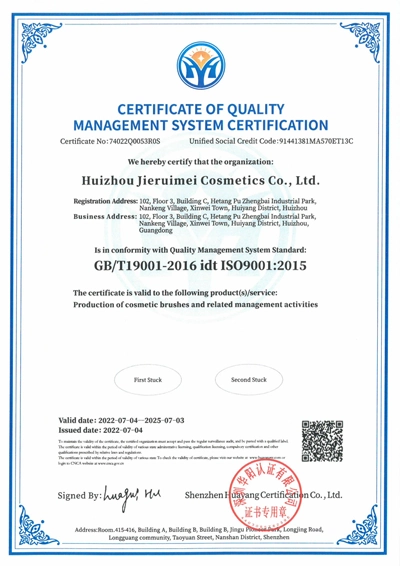
Verifying certifications like ISO 9001, BSCI, and REACH is essential for legal market access and protecting your brand’s reputation.
This confirms the supplier meets baseline standards like ISO 9001 (calidad), BSCI/SMETA (social ethics), and market-specific regulations such as EU REACH (chemical safety) and US CPSIA (for children’s products). Verifying these certifications is critical for legal market access and protecting brand reputation.
- 🏷️ Category: Regulatory Compliance
- 🎯 Core Outcome / Metric: Market Access
Analysis:
| ✅ Advantages | ⚠️ Considerations |
|---|---|
|
|
Golden Sample Protocol
The Golden Sample Protocol establishes a final, approved master reference to lock in every product specification and prevent deviations during mass production.
A critical pre-production step where a final, approved sample (el “golden sample”) becomes the unchangeable master reference for mass production. This protocol locks in all specifications, including bristle material, dimensions, color (Pantone), logo placement, and performance criteria like shedding limits. Standard lead times for samples are often 7-10 days.
- 🏷️ Category: Product Development
- 🎯 Core Outcome / Metric: Specification Lock-in
Analysis:
| ✅ Advantages | ⚠️ Considerations |
|---|---|
|
|
MOQ and Pricing Structure Analysis
Understanding a supplier’s pricing tiers allows importers to leverage volume for significantly lower unit costs and higher profit margins.
Unit costs for makeup brushes decrease significantly at higher volumes, with major price breaks often seen at 500, 1,000, y 5,000 unidades. Por ejemplo, a private label set might cost $5.00-$6.00 per set at 500 units but drop to $2.20-$3.50 per set at 5,000 unidades. Importers must also account for separate one-time setup and tooling fees.
- 🏷️ Category: Financial
- 🎯 Core Outcome / Metric: Cost Optimization
Analysis:
| ✅ Advantages | ⚠️ Considerations |
|---|---|
|
|
Integrated Packaging Development
This parallel workflow synchronizes brush and packaging design to dramatically cut down your product launch timeline.
Professional OEM suppliers can run brush manufacturing and packaging development in parallel, not sequentially. This coordinated workflow involves designing brush dimensions, packaging structures (trays, boxes), and branding artwork simultaneously, which can significantly shorten the total product launch timeline.
- 🏷️ Category: Product Launch
- 🎯 Core Outcome / Metric: Speed to Market
Analysis:
| ✅ Advantages | ⚠️ Considerations |
|---|---|
|
|
Logistics and Supply Chain Vetting
Verifying a supplier’s logistics capabilities—from production lead times to Incoterms—is essential for calculating accurate landed costs and ensuring reliable delivery.
This evaluates a supplier’s ability to deliver reliably by checking production lead times (typically 25-45 days), proximity to major ports (P.EJ., Ningbo, Shénzhen), and comprehensive knowledge of Incoterms (P.EJ., FOB, CIF). Understanding these factors is crucial for calculating accurate landed costs and ensuring timely stock replenishment.
- 🏷️ Category: Operations
- 🎯 Core Outcome / Metric: On-Time Delivery
Analysis:
| ✅ Advantages | ⚠️ Considerations |
|---|---|
|
|
Communication Standards
Establishes a clear protocol for response times and issue escalation, ensuring problems are solved quickly and efficiently.
This establishes clear expectations for supplier communication, including English proficiency, response times (P.EJ., under 24 hours for operational queries), and a tiered escalation process for critical issues like quality failures or compliance breaches. A strong framework ensures timely and effective problem resolution.
- 🏷️ Category: Supplier Management
- 🎯 Core Outcome / Metric: Efficient Problem Solving
Analysis:
| ✅ Advantages | ⚠️ Considerations |
|---|---|
|
|
Product-Specific Acceptance Standards
This protocol uses measurable, physical tests to provide objective pass/fail criteria for production batches, directly addressing performance and durability concerns.
These are measurable, physical tests used to approve or reject a production batch. Key tests for makeup brushes include the bristle shedding test (P.EJ., ≤1-2 loose hairs on a finger-pull test), the ferrule pull-force test (P.EJ., resisting ≥80-120 N for face brushes), and a handle balance check to ensure ergonomic comfort and control.
- 🏷️ Category: Seguro de calidad
- 🎯 Core Outcome / Metric: Actuación & Durabilidad
Analysis:
| ✅ Advantages | ⚠️ Considerations |
|---|---|
|
|
Why Importers Need a Structured Checklist, Not Gut Instinct
For makeup brush importers, relying on gut instinct instead of a formal checklist exposes your business to cascading failures. A single missed verification in regulations, calidad, or logistics can compound quickly, turning a profitable order into a total loss and damaging your brand’s reputation.
The compounding cost of a missed verification step
Each informal decision or skipped check creates a financial risk that grows as the product moves from the factory to the customer. A small saving upfront can lead to major costs later, from retailer penalties to complete inventory write-offs.
| Oversight Category | Potential Financial Impact |
|---|---|
| Regulatory Failures | A single missed chemical test (like REACH or CA65) can cascade into border seizures, forced product destruction, and retailer penalties, turning a profitable order into a total loss. |
| Documentation Gaps | Forgetting EU-specific documents like a PIF or CPNP registration before production can lead to months of launch delays, costly re-testing, and capital tied-up in unsellable inventory. |
| Quality Oversights | Skipping a thorough sample approval or final inspection often results in high defect rates, leading to customer returns, negative reviews, and expensive rework or replacement shipments. |
| Logistics Miscalculations | Not confirming a supplier’s peak season lead times can force expensive air freight upgrades and trigger financial penalties from retailers for late deliveries. |
Elevate Your Retail With Proven Bestsellers
Why Importers Need a Structured Checklist, Not Gut Instinct
Relying on a structured checklist instead of gut instinct helps makeup brush importers protect their margins. It turns invisible risks like chemical compliance and long-term durability into clear verification steps. This process prevents minor factory errors from multiplying into major financial losses, retailer penalties, and lasting brand damage.
The compounding cost of a missed verification step
A single missed checkpoint in the supply chain creates problems that grow in cost at each stage. Por ejemplo, failing to verify bristle density or the security of a ferrule crimp might seem small, but these issues cascade into larger failures down the line.
What might cost only a few cents to fix at the factory can turn into dollars of loss later on. If a defect is caught after shipment, the costs multiply from expensive rework, rush air freight to meet deadlines, and penalties from retailers for non-compliant products.
For makeup brushes, the customer’s experience is everything. A simple quality defect leads to negative reviews, damages your brand’s reputation, and loses repeat business. These long-term costs far exceed the original price of the product itself.
How costs multiply the later a defect is found
The stage at which a defect is identified directly determines the financial impact. The earlier an issue is caught, the cheaper it is to resolve.
- –At the sample stage:
Fixing an issue here is straightforward. It usually involves re-making samples and causes only a minor delay in the development schedule. The financial cost is minimal.
- –During production:
Finding a defect during a production run is more expensive. It often requires scrapping raw materials, halting the line for rework, and can lead to significant delivery delays.
- –After reaching the customer:
This is the most damaging scenario. The costs include processing refunds and shipping replacements. Más importante aún, it results in long-term harm to your brand’s reputation and erodes customer trust.
Business Legitimacy Verification
Verifying a supplier’s business legitimacy is a critical first step. We check their legal status by reviewing business and export licenses to ensure they are authorized to manufacture and trade cosmetic tools. This process helps avoid fraudulent operators, reduce compliance risks, and build a reliable supply chain.
Business license scope and cosmetic manufacturing authorization
| Verification Point | What to Check |
|---|---|
| Business License Scope |
We review the business license to ensure its scope explicitly includes manufacturing or trading of ‘cosmetic tools,’ ‘makeup brushes,’ or ‘beauty accessories.’ A mismatch between their advertised business and licensed scope is a significant red flag. |
| Manufacturing Permits |
We check for any local cosmetic or hygiene manufacturing permits. Factories producing items for skin contact, like makeup brushes, may need these to ensure they follow sanitary and safety standards. |
| Physical Address |
We use satellite maps or third-party audits to verify the registered address corresponds to an actual industrial facility, not a virtual office. This confirms they have a physical production site. |
| Trading Company Partners |
If working with a trading company, we request the business licenses of their partner factories. This allows us to confirm the legitimacy and production scope of the actual manufacturer. |
Export license and trade history verification tools
| Verification Point | What to Check |
|---|---|
| Export Authorization |
We confirm the supplier holds a valid export license and is registered with customs. This ensures they are legally permitted to trade makeup brushes internationally, preventing customs delays. |
| Trade History |
We ask for redacted copies of past shipping documents, like a Bill of Lading. Seeing proof of consistent export experience with makeup brushes provides confidence in their reliability. |
| Corporate Status |
We use online corporate registries to cross-check the company’s legal status. Screening the business against international sanctions lists is a key part of our due diligence to avoid trade compliance issues. |
| Financial Reliability |
We evaluate their payment history and preferred terms. For new relationships, we always use secure payment methods for the initial order to protect our investment until trust is established. |
Business license scope and cosmetic manufacturing authorization

If you import only makeup brushes, your business license needs to cover “cosmetic accessories” o “beauty tools.” Makeup brushes are typically considered general consumer goods, so you don’t need a cosmetic manufacturing license. That requirement only applies if your business manufactures, fills, or repackages cosmetic formulas, like powders or liquids integrated with the brushes.
Core Business License Scope for Brush-Only Importers
For legal and customs purposes, makeup brushes are classified as “cosmetic accessories” or general consumer products, not as cosmetics. This distinction is the most important factor in determining your licensing needs. Your core business activities do not involve handling chemical formulas.
Your business license scope must explicitly list activities like the “import and wholesale of cosmetic accessories” o “distribution of beauty tools.” This ensures your operations align with your legal registration and prevents issues during customs clearance or regulatory checks.
Alongside your primary business license, you need to secure standard operational permits. These include a seller’s permit for collecting sales tax and an importer registration number (like an EORI number in the EU) for customs processing. These are standard for any import business.
When a Cosmetic Manufacturing License Becomes Necessary
The need for a cosmetic manufacturing license is triggered when your business model expands beyond simple accessories. If you manufacture, fill, or repackage bulk cosmetic substances like liquids, cremas, or powders, you cross the line from a tool distributor to a cosmetic manufacturer.
This rule applies to any product that integrates a cosmetic formula. Examples include brushes with powder-filled handles, pre-loaded single-use applicators, or kits where you fill cosmetics into containers alongside the brushes. The act of handling the formula itself is what requires the specific license.
If you work with a supplier that produces both brushes and private-label cosmetics for your brand, the responsibility shifts. You must verify that your supplier holds the correct cosmetic manufacturing authorizations and follows Good Manufacturing Practices (GMP) for their cosmetic production lines.
Export license and trade history verification tools
Verifying a supplier’s export license and trade history is a critical step to avoid compliance issues and partner with legitimate manufacturers. We check for direct export rights through official documents and use trade data platforms to confirm a consistent shipment record, which helps prevent delays, misdeclarations, and financial risk.
Verifying Export Authorization and Licenses
To confirm a supplier can legally export directly, we request key documents. For partners in China, this includes their business license and customs exporter registration. This simple check verifies they have direct export rights and aren’t solely a domestic trading company, which protects our supply chain integrity.
We also review the HS codes the supplier uses for makeup brushes. Consistent use of correct codes, such as those in Chapter 96, shows they understand customs requirements. This practice helps prevent costly delays or penalties from misdeclaration at the border.
If any components originate from the US, we ensure compliance by asking the exporter to confirm their EAR99 status. We also verify if a BIS export license is needed for the specific materials or destination, protecting our operations against trade control violations.
Using Trade Data to Assess Shipment History
Beyond official licenses, we use commercial import-export data platforms to analyze a supplier’s actual shipment history. This allows us to see if they have a consistent record of exporting makeup brushes to our target markets, which proves their experience and operational reliability.
This analysis helps us spot red flags early. A supplier claiming to be a large manufacturer but having no visible export history is a major concern. We also check if customs data reveals they are only a trading company, which could impact transparency and margins.
We corroborate this data by reviewing supplier profiles on B2B marketplaces. We look for verified supplier badges, on-site inspection reports, and a clear transaction history. These details help build a complete picture of their export activity and legitimacy before we commit to a partnership.
Production Capability Assessment

When choosing a makeup brush supplier, we assess their production capability to ensure they can consistently handle our order volume, maintain quality, and manage their supply chain effectively. Verifying factory size, equipo, output, and production model is essential for avoiding bottlenecks and protecting long-term profitability.
Factory size, machinery, and monthly output capacity
A supplier’s physical and technical resources directly impact their ability to deliver consistent quality on time. We look for concrete evidence of scale and specialization, not just verbal promises, to confirm a partner can support our brand’s growth without compromising quality.
|
Factory Size & Layout |
A large enough factory can manage multiple product lines and repeat orders without creating bottlenecks. A well-organized facility with separate, dedicated areas for raw materials, producción, quality inspection, and finished goods storage shows a professional approach to manufacturing and reduces risks of contamination or errors. |
|
Specialized Machinery |
We confirm that the factory owns specialized equipment for all critical production steps. This includes machinery for bristle shaping, combing, gluing, and ferrule crimping. They should also have dedicated tools for quality control, such as pull testers to check for bristle shedding and handle durability. |
|
Monthly Output Capacity |
Claimed output capacity must be validated with recent production records. We look for suppliers who can consistently produce volumes that meet our forecasts, especially for specific brush types we need. A reliable supplier can provide a breakdown of their output, not just a single aggregate number. |
Whether production is in-house or partially outsourced
Understanding a supplier’s production model is key to managing quality and risk. Whether they manufacture everything themselves or rely on subcontractors directly affects our ability to control the final product.
|
In-House Production |
We prefer suppliers who manage all critical stages of OEM cosmetic brush production in-house. This gives us tighter control over raw material sourcing, assembly processes, and final quality checks. Direct oversight reduces variability and makes troubleshooting defects more straightforward. |
|
Partial Outsourcing |
If a supplier outsources any part of the process, they must be transparent. We require them to disclose which steps are external, how they audit their subcontractors, and where final quality control happens. A supplier’s inability to explain this is a major red flag that hides potential quality risks. |
|
Verification of Critical Stages |
We always verify that the most important manufacturing stages are managed directly by our primary supplier. These include bristle preparation and shaping, ferrule assembly and crimping, final quality inspection, y embalaje. Keeping these core steps in-house is essential for product consistency. |
Production Capability Assessment
When we evaluate a makeup brush supplier, we confirm their production capability by assessing factory size, essential machinery, and monthly output. This ensures they can handle our order volumes consistently. We also determine if production is fully in-house or partially outsourced to manage quality control and supply chain reliability effectively.
Factory size, machinery, and monthly output capacity
A supplier’s scale is a strong indicator of their ability to handle our orders. A mid-sized factory, typically between 5,000 a 10,000 square meters with 100 a 300 empleados, is well-suited for mainstream private-label programs. Larger facilities over 10,000 metros cuadrados, with a workforce of 300 a 800 o más, are built for high-volume orders serving major brands.
The right equipment is essential for consistent quality. We verify that a factory has machinery for all core processes: bristle processing and shaping, handle production, and precise ferrule crimping. Automated branding tools, like hot stamping or laser marking machines, are also important for achieving a professional finish on our products.
Monthly output directly reflects a factory’s capacity. We look for suppliers who can produce a minimum of 300,000 brushes per month for developing partnerships. Established, large-scale operations often have the capacity to produce over 5,000,000 cepillos mensuales, providing the scalability we need as our brand grows.
Whether production is in-house or partially outsourced
Understanding a supplier’s production model is key to managing quality and lead times. We verify if all core manufacturing steps—from bristle shaping and handle finishing to final assembly and printing—are completed end-to-end within their own factory. This in-house control generally leads to more reliable outcomes.
We also ask about any outsourced components. It’s common for suppliers to source specialized parts like complex packaging or unique ferrules from partners. Knowing this helps us assess the full supply chain and potential risks.
Fully in-house production gives us better direct control over quality and timelines. Partial outsourcing, por otro lado, can provide access to unique materials or technologies. Our goal is to find a partner with a transparent process, whether they manufacture everything themselves or manage a network of trusted subcontractors.
Whether production is in-house or partially outsourced
Choosing a supplier requires understanding their production model. An in-house approach offers greater control and consistency, while partial outsourcing provides flexibility and scalability. Verifying which model a supplier uses is critical for managing quality, lead times, and overall supply chain risk.
The In-House Production Model: Control and Consistency
When we manage production in-house, we gain direct control over every critical manufacturing step. This includes bristle processing, ferrule forming, and final assembly, ensuring each component meets our standards.
This level of oversight results in greater consistency between the approved sample and your bulk order. Because accountability for any defects is direct, we can maintain strict quality management and protect your product integrity.
The in-house model is best suited for importers with large, stable product lines who need a reliable partner capable of consistent, high-quality output.
The Partial Outsourcing Model: Flexibility and Vetting
To increase capacity, speed up production, or reduce costs, a supplier might outsource non-core parts like handles or packaging. This hybrid approach adds valuable flexibility to the supply chain.
It offers scalability that benefits startups or brands launching seasonal products with lower initial volumes. You can adapt quickly to market demands without committing to large-scale production from the start.
For any brand, it is essential to verify which specific steps are outsourced. We always confirm that our external partners are audited under the same quality standards we apply internally, ensuring consistency across the board.
Quality Management: Process, Rejection Rate, and Consistency
Our quality management is built on rigorous checkpoints at every stage and an unbreakable link between the approved sample and bulk production. We use a “golden sample” protocol and multi-stage inspections to ensure the brushes you receive are identical to the ones you approved. This process protects your investment by minimizing defects, ensuring consistency, and delivering a product that builds your brand’s reputation.
QC Checkpoints Across the Production Line
Incoming Materials Inspection: We verify all raw materials—bristles, férulas, and handles—against your specifications and master samples before they enter the production line. This catches potential issues early and prevents downstream defects.
In-Process Controls: At each assembly stage, we monitor key manufacturing parameters. This includes bristle bundle weight for density, glue volume for durability, and ferrule crimping force for a secure build.
Final Assembly & Functional Tests: Every finished brush is checked for straightness and ferrule security. We also conduct performance tests, including bristle shedding tests and softness comparisons against the golden sample, to ensure function matches form.
Outgoing AQL Inspection: Before packing, we perform a final, statistically based AQL (Acceptance Quality Limit) inspection. This systematic check identifies and filters any remaining critical, major, or minor defects from the shipment, ensuring the batch meets your standards.
How Consistency Is Maintained Between Sample and Bulk
Golden Sample Protocol: We establish a master “golden sample” that you sign and approve. This sample, along with a detailed technical sheet, becomes the definitive quality reference for all our production and QC teams.
Pre-Production (PP) Sample Approval: Before starting mass production, we create a PP sample using the final production line and materials. Your approval on this sample confirms our process is repeatable and ready for scaling.
Standardized Tooling & Parameters: We use fixed jigs to maintain consistent bristle shaping and precise logo placement. Key machine settings, like crimp force and glue volume, are documented and locked to ensure every brush is made the same way.
In-Line Audits: Our production line leaders and QC staff constantly compare brushes from the active production run directly against the master sample. This allows us to catch and correct any deviations in real-time.
Quality Management: Process, Rejection Rate, and Consistency
Our quality management relies on structured checkpoints at every stage of production. We use tight process controls to make sure every brush matches the approved sample, which keeps rejection rates low and product quality high.
QC checkpoints across the production line
To prevent defects and ensure quality, we built a multi-stage inspection process. Catching issues early is far more efficient than finding them in finished products. Our system is designed to verify quality from raw materials all the way to the final sealed carton.
- Pre-production Inspection: Raw materials like bristles, férulas, and handles are checked for defects and batch consistency before manufacturing begins.
- In-line Process Control: Key assembly steps, such as bristle insertion, gluing, and ferrule crimping, are monitored to catch errors as they happen.
- Final Product Testing: Finished brushes undergo visual, dimensional, and performance tests for issues like bristle shedding, manejar grietas, or poor makeup application.
- Pre-shipment Verification: Cleanliness, correct packaging, and final counts are confirmed before goods are sealed in cartons for dispatch.
How consistency is maintained between sample and bulk
Ensuring the brushes you receive are identical to the sample you approved is our top priority. We use a system of documented standards and process controls to lock in quality and prevent variations between batches.
- Batch Traceability: All raw materials, from bristles to adhesives, are tracked by lot number, allowing for rapid isolation of any variations or defects.
- Stage-Gate Inspections: Quality is verified at multiple stages—not just at the end—to ensure issues are caught early and prevent the accumulation of defects.
- Standardized Criteria: un claro, documented set of pass/fail standards for defects, dimensions (often ±1 mm), and performance is applied equally to every unit produced.
- Process Controls: Key processes like glue curing and adhesive application are tightly managed to prevent common failures such as loose ferrules or bristle shedding.
How consistency is maintained between sample and bulk
Maintaining consistency between the sample you approve and the final bulk order relies on a strict system of controls. This involves locking in a master ‘golden sample’ as the benchmark, defining every detail in a technical specification sheet, verifying raw material batches match, and conducting inspections throughout production to catch deviations early.
Common causes of sample-to-bulk deviation
When a bulk order doesn’t match the approved sample, it’s usually due to a few common issues. Bristle softness or color can change if the factory uses a different batch of raw materials for mass production. Small variations in assembly, like how tightly the ferrule is crimped, can affect bristle retention and feel. Inconsistent glue application is another major factor that impacts long-term durability. We also watch for dimensional drift, where the size of the handle, contera, or brush head shifts slightly during a large production run.
Key controls to enforce production consistency
To prevent these deviations and protect your investment, we enforce several key controls throughout the manufacturing process. These steps ensure that the quality you approve is the quality you receive.
- Sealed ‘Golden Sample’: We start by approving a sealed ‘golden sample’ that serves as the non-negotiable standard for the entire bulk production run.
- Detailed Technical Specifications: We create a comprehensive technical spec sheet that defines all critical tolerances, such as ±1 mm for key dimensions, leaving no room for guesswork.
- In-Process Inspections: We conduct inspections directly on the production line. This allows us to identify and correct any deviations immediately, before the entire batch is completed.
- Raw Material Verification: Before mass production begins, we verify that the raw material batches for the bulk run match those used for the approved sample, ensuring consistent look and feel.
Certifications: Market-Specific Compliance Documents
For makeup brush importers, certifications are essential for verifying a supplier’s quality, seguridad, and ethical standards. They are divided into baseline documents like ISO 9001 and BSCI, which confirm operational maturity, and market-specific requirements like EU REACH and US CPSIA, which ensure legal compliance for chemical and product safety in target regions. Securing these documents is a critical step to prevent defects, reduce risks, and gain access to major retailers.
Required Baseline: ISO 9001, GMP, BSCI or SMETA
These certifications establish a factory’s fundamental commitment to quality, hygiene, and ethical operations. They are often a prerequisite for doing business with established brands and retailers, as they help mitigate common risks in the production of cosmetic tools.
| Certification | What It Verifies for Importers |
|---|---|
| ISO 9001 |
Validates the factory has a formal Quality Management System (QMS) to prevent common defects like bristle shedding or loose ferrules. |
| GMP |
Ensures hygienic production and packaging (Good Manufacturing Practices) to reduce contamination risks for cosmetic tools that contact skin. |
| BSCI or SMETA |
Verifies social and ethical compliance regarding labor, health, y seguridad, which is often a precondition for supplying major retailers. |
Market-Specific: EU REACH, US CPSIA, and Cruelty-Free Declarations
Beyond the baseline, specific documents are required to legally sell products in certain markets or to make specific marketing claims. Failing to secure these can result in customs seizures, recalls, and significant financial loss.
| Document/Standard | What It Verifies for Importers |
|---|---|
| EU REACH |
Confirms that chemical substances used in paints, glues, and materials comply with European Union safety standards. |
| US CPSIA |
Mandatory for children’s brush sets sold in the US, regulating lead and phthalate content and requiring a Children’s Product Certificate (CPC). |
| Cruelty-Free Declaration |
A statement confirming no animal testing was performed. It also specifies if bristles are synthetic, supporting vegan claims. |
Certifications: Market-Specific Compliance Documents
Verifying baseline factory certifications like ISO 9001 and market-specific documents such as EU REACH is essential for makeup brush importers. This process confirms product safety, supply chain integrity, and legal access to key markets, reducing the risk of recalls and protecting profit margins.
Required baseline: ISO 9001, GMP, BSCI or SMETA
An ISO 9001 certification shows that a factory operates a formal Quality Management System. For us, this means consistent production processes and reliable traceability for materials like bristles and handles. It directly reduces the risk of batch-to-batch quality variations that can lead to defects and customer returns.
Good Manufacturing Practices (GMP), often aligned with the ISO 22716 standard for cosmetics, focus on hygiene and facility cleanliness. Because makeup brushes make direct contact with skin, a GMP-compliant environment helps control contamination risks, ensuring the final product is safe for consumers.
Social audits like BSCI or SMETA verify that a factory adheres to ethical labor standards, including fair wages and safe working conditions. Many major retailers require these audits before they will stock a product, so compliance makes it easier to gain access to valuable sales channels.
Market-specific: EU REACH, US CPSIA, cruelty-free declarations
For products entering the European Union, EU REACH regulations restrict specific chemicals in the materials we use, including coatings, ferrule metals, and glues. Confirming REACH compliance is not optional; it is a mandatory step to prevent border seizures, recalls, and blocked market entry.
In the United States, regulations like the CPSIA set strict limits on hazardous substances such as lead. This is particularly relevant for the paints and materials used in our brush handles. Adhering to these standards ensures consumer safety and protects our partners from legal and financial risks in the US market.
Cruelty-free declarations are formal statements that brands require to support their marketing claims. These documents verify that no animal testing occurred anywhere in the supply chain. This is crucial for aligning with modern consumer values and maintaining brand integrity.
Certifications: Market-Specific Compliance Documents
When importing makeup brushes, we verify both baseline factory certifications and market-specific compliance documents. This two-part approach helps manage quality, ethical, and legal risks. Baseline certifications confirm a supplier’s operational stability, while market-specific documents ensure our products are ready for sale in specific regions like the EU or US.
Required baseline: ISO 9001, GMP, BSCI or SMETA
We look for ISO 9001 certification to confirm a factory has a dependable quality management system. This system ensures consistent processes for everything from material sourcing to final inspection, which reduces the risk of batch-to-batch variations in our brushes.
Good Manufacturing Practices (GMP) are critical for hygiene and safety, especially since these tools are used on skin. We verify that our suppliers follow GMP guidelines, often aligned with ISO 22716 for cosmetics, to control contamination risks during production and packaging.
A BSCI or SMETA audit report shows that a supplier meets ethical labor and social standards. Reviewing these audits helps us partner with factories that provide safe working conditions and fair treatment for their employees, aligning with our brand values and retailer requirements.
Market-specific: EU REACH, US CPSIA, cruelty-free declarations
For products entering the European Union, we confirm compliance with REACH regulations. This involves tracking all chemicals in brush components—like handles, glues, and coatings—to ensure they don’t contain Substances of Very High Concern (SVHCs) above the legal limit.
In the United States, the CPSIA sets strict limits on lead and phthalates, mainly for children’s products. We often apply these safety standards across all our brushes to ensure they meet broad retail and consumer expectations for safety, regardless of the target age group.
Cruelty-free declarations are essential for many cosmetic brands. We obtain these documents from our suppliers to verify that no animal testing occurred on any components and that no animal-derived materials were used, which is a core requirement for vegan-friendly product lines.
Sampling Policy: Timelines, Fees, and Golden Sample Protocol
A formal sampling policy is crucial for setting clear expectations on quality, costo, and timing with makeup brush suppliers. This process typically involves a standard sample lead time of 7–10 days, defined fees that are often refundable on a bulk order, and a detailed “golden sample” protocol. The golden sample becomes the non-negotiable standard that all mass-produced units must match.
Establishing a clear and documented sampling process is one of the most effective ways to manage risk when importing makeup brushes. It converts abstract quality expectations into a physical, approved standard, preventing costly misunderstandings and ensuring the final product aligns with your brand’s requirements.
Sampling Timelines
For most standard brush designs, you can expect a sample lead time of about 7 a 10 days. Fully custom OEM projects that require new tooling or material development will naturally take longer. Once you approve the final sample, the transition to mass production is typically 30 a 45 days. It’s wise to build buffer time into your launch schedule to accommodate potential revisions for details like color matching, bristle density, or logo placement.
Sample Fees and Payment Terms
Suppliers commonly charge a fee of $50 a $200 per design for samples. This cost covers the materials, setup, and prototype labor needed to create a representative unit. Before committing, we always clarify in writing whether these fees are refundable or if they will be credited toward your first bulk order. This simple step helps manage development costs and aligns expectations from the start.
What a complete golden sample protocol should include
The golden sample is the single, master reference unit that defines quality for the entire production run. A weak or incomplete protocol is a common source of quality disputes. Your agreement should lock down every key detail to ensure both your team and the factory’s production line are working from the same benchmark.
| Component/Area | Key Details to Specify |
|---|---|
| Producto & Material Specs | Details like SKU, brush function, handle/ferrule/bristle materials, fiber grade, densidad, and adhesives. |
| Appearance & Color Standards | Approved color codes (P.EJ., Pantone), logo placement, surface finish requirements, and acceptable limits for cosmetic defects. |
| Actuación & Dimensional Criteria | Measurable standards for bristle shedding, shape retention, and pull-force, plus precise dimensional tolerances for the handle, contera, and brush head. |
| Embalaje & Labeling | Final approval for the retail box or pouch, including barcode placement and any required compliance or care instructions. |
| Documentation & Control | Dated approval records with signatures from both parties, reference photos, and rules for how production lots are checked against the master sample. |
Sampling Policy: Timelines, Fees, and Golden Sample Protocol
A clear sampling policy is essential before starting production. For standard makeup brushes, expect sample lead times of 7–10 days, with fees typically between $50 y $200 per design, often credited back on a bulk order. The most critical step is finalizing a ‘golden sample’ protocol. This locks in the approved design, materiales, and quality standards that all mass-produced units must match.
What a complete golden sample protocol should include
To prevent inconsistencies between the approved sample and the final production run, a golden sample protocol establishes a single source of truth. A comprehensive protocol should contain these five core elements:
- A master reference sample and a detailed written specification sheet. This locks in the final approved design, covering fiber, head shape, contera, manejar, and all decorative elements.
- Measurable technical data. This should cover all dimensions, materiales, color standards, and key functional performance metrics, such as shedding limits after testing.
- Finalized artwork, embalaje, and labeling requirements. This ensures the product arrives fully retail-ready and compliant with your market’s regulations.
- A formal sign-off document. It needs a version number, date, and high-resolution photos, confirming both parties agree this sample is the standard for mass production.
- A rule for retaining physical reference samples. Both the importer and the factory must keep a sealed master sample for future quality control comparisons.
MOQ and Pricing Structure: Tiered Costs and Hidden Fees
Understanding how order quantity affects your unit cost is key to managing your budget. Prices for makeup brushes drop significantly as you scale from 500 a 5,000 units because fixed production costs get spread across more items. You’ll also encounter one-time charges for customization, like setup and tooling fees, but we can often negotiate to have these credited toward a larger bulk order.
How unit cost shifts across 500, 1,000, y 5,000 unidades
Your price per brush isn’t static; it changes based on the size of your order. Smaller runs have a higher per-unit cost because the initial expenses for setup and materials are divided among fewer items. As your order grows, you benefit from economies of scale, making each brush more profitable.
| Quantity Tier | Typical Unit Cost Behavior |
|---|---|
| 500 Units | This tier has the highest price per unit. All the fixed setup and tooling costs are spread across a very small quantity, making each brush more expensive to produce. |
| 1,000 Units | You’ll see a notable price drop here, usually around 10-25%. This quantity is often the entry point for standard production runs where efficiencies begin to kick in. |
| 5,000 Units | This is where you hit the baseline bulk price, which can be 25-45% lower than the 500-unit cost. We can optimize material purchasing and make production much more efficient at this scale. |
Be aware that pricing advertised on many B2B platforms often shows the most competitive rate for 5,000+ unidades. If you plan a smaller order, expect a higher per-unit cost.
Setup fees, tooling costs, and what is creditable toward bulk orders
Beyond the per-unit price, some non-recurring fees may apply, especially for custom projects. These cover the specialized work needed to bring your unique design to life. Here’s a breakdown of what to expect.
| Fee Type | Descripción |
|---|---|
| Setup Fees | These are one-time charges for services like creating a printing plate for your logo or formulating a custom handle color. |
| Tooling Costs | This cost comes up when we need to create new physical molds for custom parts, such as a unique handle shape, a special ferrule, or a custom packaging component. It’s a significant upfront investment for highly tailored products. |
| Creditable Fees | To build a strong partnership, suppliers often credit initial sampling or development fees against your first bulk order (typically 1,000 units or more). This helps offset initial costs and incentivizes a larger commitment. |
When comparing different suppliers, always ask for a quote that separates the per-unit price from these one-time fees. This gives you a clear and accurate picture of the total cost and helps you make the best financial decision for your brand.
Logistics: Lead Times, Port Proximity, and Incoterms Knowledge
Managing logistics for your brush orders requires looking beyond a supplier’s quoted production time. You must plan for the total journey from the factory to your warehouse, understand how a factory’s location impacts shipping costs, and use trade terms like Incoterms to clearly define who is responsible for each part of the shipment. This protects both your timeline and your margins.
Production Lead Times vs. Total Shipping Time
When a supplier quotes a lead time, they are typically referring only to the manufacturing period. The total time until your brushes arrive is longer. We need to account for additional stages like final quality control, secure packaging for transit, and the truck journey from the factory to the port. A standard 25-45 day production window can easily become a 45-90 day door-to-door timeline after adding ocean freight and customs clearance.
Larger orders, such as one for 5,000 unidades, can be produced more efficiently per brush. But the overall manufacturing window to complete the entire batch will be longer than for a small run. Planning for this extended production time is essential to ensure your inventory arrives when you need it.
Impact of Port Proximity and Incoterms on Costs
Working with a factory located in a major port city like Ningbo or Shenzhen can directly lower your landed cost. The shorter the distance to the port, the less you pay for domestic trucking. It also means your order gets onto a vessel faster, which helps shorten your overall lead time.
Always clarify Incoterms when getting a quote. An ex-factory (EXW) price just covers the cost of the product itself, leaving you to manage and pay for all shipping. A Free on Board (FOB) price is often a better starting point, as it includes the cost of transporting the goods to the port and loading them onto the ship.
Your shipping plan must align with your production volume. If a large order is finished but your container isn’t booked, you can face extra storage fees at the factory or port. These unplanned costs can quickly reduce the savings you gained from placing a large order.
MOQ and Pricing Structure: Tiered Costs and Hidden Fees
When sourcing makeup brushes, the unit price drops significantly as your order quantity increases from 500 a 5,000 unidades. This happens because fixed costs are spread across more brushes. You also need to account for one-time setup and tooling fees, but we find these can often be negotiated as a credit toward your first bulk purchase.
How unit cost shifts across 500, 1,000, y 5,000 unidades
Makeup brush suppliers use tiered pricing, so your cost per brush decreases as the order volume gets bigger. Por ejemplo, a private-label brush set that costs you $5.00 at 500 units might drop to around $3.50 at 1,000 units and as low as $2.50 at 5,000 unidades.
This price drop happens because fixed costs, like setting up the production line or creating printing plates, are spread across more items. A larger order makes each individual brush cheaper for us to manufacture. Always ask for a formal price breakdown for different quantities. This helps you see the exact savings and decide on the most cost-effective order size for your business needs.
Setup fees, tooling costs, and what is creditable toward bulk orders
You might see separate charges for setup and tooling. Setup fees cover one-time costs like preparing for logo printing. Tooling costs pay for creating new molds, which are needed if you want a custom handle or unique ferrule shape. These fees are more common for custom designs than for our standard private-label items.
We can often negotiate these upfront costs. Ask if we can credit them back against your first large purchase order. It’s important to get any agreement like this in writing. También, clarify who owns any custom tooling you pay for. This determines if you have the right to use those molds with another manufacturer down the road.
Packaging Capability: OEM Packaging Integration
Sí, experienced OEM suppliers can run brush and packaging development in parallel to significantly shorten your time-to-market. We manage brush engineering, structural packaging design, and artwork through overlapping workstreams under a single, unified project timeline. This approach uses key data points, like final brush dimensions, as milestones to finalize packaging without costly restarts.
Whether brush and packaging development can run in parallel
With an experienced OEM supplier, brush and packaging development can and should run in parallel, not sequentially. This concurrent process is designed to shorten your product launch cycle. We use a system of overlapping workstreams for brush engineering, structural packaging design, and artwork development, all managed under one project timeline.
The process starts with your brand brief. From there, our teams begin designing the brush and the structural packaging at the same time. Key data points, such as final brush dimensions and weight, act as specific milestones. Once these are confirmed, the packaging design can be finalized without having to restart the entire process. This integrated approach prevents costly delays and ensures a perfect fit.
Success depends on having integrated manufacturing facilities, shared technical data like CAD files and Bills of Materials (BOMs), and a unified project management system. This ensures all teams are working from the same information. A typical parallel development timeline is structured to manage these dependencies efficiently.
| Phase | Typical Timeline | Key Activities |
|---|---|---|
| 1. Brief & Specification | Weeks 1-2 | Define brush lineup, materiales, and handle finishes. Propose initial packaging concepts like box style and insert type. |
| 2. Prototyping | Weeks 2-4 | Produce first-round brush samples. In parallel, develop structural packaging mockups and artwork dielines. |
| 3. Refinement & Lock-in | Weeks 4-6 | Adjust brush specifications based on feedback. Finalize the set configuration and brush count. Fine-tune packaging with locked brush dimensions. |
| 4. Pre-Production Validation | Weeks 6-8 | Produce a final pre-production set, including final brushes in final printed packaging. Conduct fit checks and transit tests. |
| 5. Mass Production | Weeks 8-12+ | Release bulk brush production and packaging printing. Final assembly, control de calidad, and packing into master cartons. |
You can verify a supplier’s capability by requesting a project plan that shows these parallel workstreams. It is also a good idea to ask how the factory controls tolerances between the brush and its packaging to guarantee a secure fit and a high-quality unboxing experience for your customers.
Packaging Capability: OEM Packaging Integration
Sí, we can run brush and packaging development at the same time. This parallel process is a standard practice we use to shorten your time-to-market. It works by freezing critical interface specifications early on—like the bottle neck, wiper design, and stem geometry. Once those are locked, our teams can develop the brush and container concurrently, ensuring perfect compatibility and a faster launch.
Whether brush and packaging development can run in parallel
Running brush and packaging development in parallel is a standard industry practice we follow. It’s specifically designed to shorten time-to-market, which is a major advantage when working with an integrated supplier like us.
The process requires locking in critical interface specifications early. We work with you to finalize details like the bottle neck, wiper design, and stem geometry. Freezing these specifications ensures both components are mechanically compatible from the start.
Once these interfaces are set, our brush team can focus on refining application performance. At the same time, our packaging team finalizes all the container engineering and decoration. This concurrent workflow means no time is wasted waiting for one part to finish before the other can begin.
A successful parallel development depends on a shared technical specification and strong project management on our end. This approach helps mitigate risks, such as mechanical interference or a mismatch between the product and the applicator, ensuring a smooth and efficient development cycle.
Logistics: Lead Times, Port Proximity, and Incoterms Knowledge
When partnering with a makeup brush supplier, a clear grasp of their logistics is essential. Understanding their lead times, factory location relative to major ports, and knowledge of shipping terms (Incoterms) directly protects your launch dates, landed costs, and supply chain stability.
Calculating Total Lead Time and Port Impact
The total lead time for makeup brushes can span 45–90 days. This timeline covers everything from initial development and raw material sourcing to final production and international shipping.
A supplier’s factory location plays a big role in this. A factory within 1-4 hours of a major port like Ningbo or Shenzhen helps reduce inland trucking costs and gives you more shipping options.
You also need to account for potential delays. Custom bristle orders, color-matching rework for handles, and production bottlenecks during the peak holiday seasons in Q3 and Q4 can all extend your timeline.
Why Supplier Incoterms Knowledge is Critical
Incoterms are the rules that clarify who pays for each part of the shipping journey. They also define the exact moment the risk for lost or damaged goods transfers from the supplier to you.
If you want more control over shipping, terms like FOB or FCA are common choices that let you manage the main freight. Many suppliers will quote CIF, which includes the cost of shipping and insurance to a port in your country.
Misunderstanding these terms can lead to surprise fees, customs delays, and mistakes in calculating your landed cost. This directly affects your product’s profit margins, so ensuring your supplier has a firm grasp on them is critical.
Communication Standards: Language, Response Time, and Escalation
Clear communication standards prevent costly misunderstandings when importing makeup brushes. This involves setting expectations for language, establishing service level agreements (SLAs) for response times, and creating a formal, multi-tiered escalation framework to handle critical issues like regulatory failures or major quality defects.
Setting Clear Language and Response Time Expectations
We use English as the default language for all critical documents. This includes specifications, contracts, and compliance reports to ensure there is no room for misinterpretation in our partnership.
To avoid confusion, we align on a shared glossary for technical terms. This makes sure we mean the same thing when discussing bristle types (PBT, pelo de cabra), performance metrics (shedding, pick-up), and compliance acronyms like REACH or MoCRA.
We establish service level agreements (SLAs) to keep projects on track. You can expect responses to routine inquiries and quotes within 24-48 horas. Complex custom development might take 3-5 working days to address thoroughly.
Our communication plans also account for time zones and public holidays. We set expectations for communication during overlapping work hours and appreciate advance notice for major closures like Chinese New Year to prevent unexpected delays.
Establishing a Formal Escalation Framework
A formal escalation framework helps us resolve critical issues quickly and effectively. We define clear triggers for when an issue needs to be escalated, such as regulatory non-compliance (REACH, CA65), unapproved material substitutions, or major quality defects that impact product safety or performance.
The process uses a three-tiered path to ensure the right people are involved. Level 1 involves daily sales contacts for routine issues. Level 2 brings in factory QC managers for technical problems. For critical failures that risk a product launch or our partnership, Level 3 engages senior management.
To make escalations productive, all issues must be submitted with structured evidence. This includes photos, third-party inspection reports, and copies of the agreed-upon specifications so the problem can be analyzed without delay.
For any escalated issue, we require a formal Corrective and Preventive Action (CAPA) plan. This plan documents the root cause of the problem and outlines the exact steps we will take together to prevent it from happening again.
Makeup Brush-Specific Acceptance Standards
Makeup brush acceptance standards give us measurable criteria to approve or reject batches from suppliers. For private-label or OEM production, three critical quality control checks are the bristle shedding test, the ferrule pull-force test, and the handle balance check.
Bristle shedding test
This test verifies the bond strength between the bristles and the ferrule. A strong bond ensures minimal to no fallout during makeup application and routine washing, which is critical for customer satisfaction and brand reputation. Excessive shedding is a common reason for negative reviews and returns.
Common test methods range from manual pulls and shakes to more rigorous mechanical vibration tests. These tests simulate repeated use over several months. For premium brushes, a common performance target is losing five or fewer bristles per 100 test cycles. To quantify the bond strength more precisely, single-bristle pull-out tests measure the force needed to detach one bristle, with benchmarks like 0.5 Newtons (N) or more for high-quality synthetic bristles.
Ferrule pull-force test
The ferrule pull-force test measures the structural integrity of the joint between the brush handle and the metal ferrule. This check confirms the brush can withstand regular use without the head becoming loose, wobbly, or detaching completely. A secure joint is fundamental to the brush’s durability and safety.
We use an axial pull test, where a machine applies a steady pulling force to the joint until it fails or reaches a minimum threshold. The required force varies by brush size. For smaller eye brushes, the joint should withstand at least 40 N. For larger, heavier face brushes, the minimum force requirement increases to 80 N or more to ensure a robust, long-lasting construction.
Handle balance check
A handle balance check evaluates the brush’s ergonomics and feel. By finding the brush’s center of gravity, we can see how it relates to where a user naturally grips it. This assessment is key to user comfort and the brush’s performance for its intended technique.
A well-balanced brush gives the user precise control and feels comfortable in the hand, avoiding a “head-heavy” o “handle-heavy” sensation. Por ejemplo, detail brushes often have their balance point closer to the ferrule for better tip control, while larger face brushes are balanced to support broad, movimientos de barrido. This attention to ergonomics elevates the user experience and reinforces the quality of the product.
Pensamientos finales
Focusing only on unit price leaves your business exposed to predictable supply chain failures. This checklist is a financial tool designed to convert hidden risks—from quality control to customs compliance—into verifiable checkpoints. A reliable supply chain is built on systematic verification, not guesswork.
The checklist provides the framework, but validation requires action. Put our process to the test by requesting our complete certification and compliance documentation. For those ready to move forward, our team is prepared to develop a custom OEM sampling plan for your brand.
Frequently Asked Questions
What information do I need to provide a supplier to get an accurate quote?
Provide a detailed spec sheet covering brush type, materials for bristles, contera, y manejar, plus branding and packaging requirements. Include order quantity, target price, and any market-specific compliance needs. A complete request ensures you receive precise and comparable quotes, avoiding later surprises or hidden fees.
Should I use FOB or CIF Incoterms for a first order?
For a first order, FOB (Free On Board) is generally better. It gives you direct control over your shipping and insurance costs, providing full transparency. This makes it easier to compare the actual product prices between suppliers. CIF may seem simpler, but it can hide freight markups from the supplier’s forwarder.
How do I verify the factory’s certifications are real and current?
Ask for a complete digital copy of each certificate. Check that the factory name, address, and scope match your supplier’s details. Most importantly, use the certificate number to check its status directly on the issuing body’s official website. Always confirm the expiration date is still valid for 2026.
How large should my first order be when working with a new supplier?
Your first order should be a pilot run—large enough to meet the supplier’s MOQ but small enough to limit your financial risk. The goal is to test their production consistency against your approved sample and evaluate their communication and logistics. This approach validates the supplier before you place larger-scale orders.