

A makeup brush factory audit helps buyers identify production, качество, and supply-chain risks before placing an order, reducing the likelihood of costly defects and delivery problems.
This guide explains how buyers can verify a makeup brush supplier’s legal identity, production capability, process controls, and quality systems. Drawing on its experience in makeup brush manufacturing, БС МОЛЛ also highlights the practical checks buyers should complete to reduce subcontracting, качество, and compliance risks before approving production.
Verify the Legal Entity, Payment Entity, and Actual Production Site

Confirm the identities of the contracting entity, payment entity, and actual manufacturer, and verify that the relationship among them is clearly documented. This ensures authenticity and reduces fraud risks.
Check the Contracting Entity
Review the supplier’s business license or company registration record. Confirm its legal name, registration number, address, status, and registered activities through an official registry where available. Например, UK-registered companies can be checked through the free Companies House register.
Where the registry provides this information, the registered activities should be reasonably consistent with the supplier’s claimed role. If the contracting entity appears to be a trader or wholesaler, request documents explaining its relationship with the factory.
Confirm the Payment Entity
Check whether the beneficiary named in the payment instructions matches the contracting entity. If payment is made to an affiliated or authorized company, such as a Hong Kong trading entity, request evidence connecting it to the supplier or factory.
Avoid payments to personal or unrelated third-party accounts. Any unexplained difference between the contract and bank-account names should be resolved before funds are transferred.
Verify the Production Site
Confirm that the disclosed address is an operating factory rather than only a sales office. Request current, location-specific photos or live video showing relevant production areas, оборудование, assembly lines, and warehouses.
The factory profile should state the site address, main production processes, оборудование, and approximate capacity. Where appropriate, verify the site through an on-site or qualified third-party audit.
Different entities or addresses are not automatically a problem, but their relationships should be transparent, documented, and consistent across relevant records. Buyers should also verify the manufacturer’s certifications and test reports against the legal entity and actual production site. Use the following checks to identify unexplained discrepancies.
| Verification Area | What to Verify | Warning Signs |
|---|---|---|
| Contracting entity | Legal name, registration number, registered address, company status, business activities, and relationship with the factory | Inactive registration, inconsistent company details, or no documented link to the manufacturer |
| Payment entity | Beneficiary name, bank-account ownership, authorization, and relationship with the contracting entity or factory | Personal accounts, unrelated third parties, or unexplained differences between contract and payment names |
| Production site | Operating address, production areas, оборудование, workforce, relevant processes, warehouse, and approximate capacity | Sales office presented as a factory, undisclosed production sites, or capacity claims unsupported by observed operations |
| Cross-document consistency | Names, addresses, and relationships across contracts, payment records, factory profiles, audit reports, and relevant certificates | Contradictory information, unexplained name changes, or documents referring to different facilities |
Review the Makeup Brush Production Process On Site

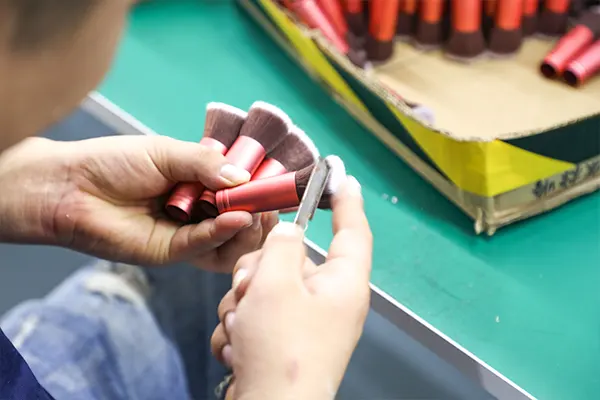
An on-site production review helps buyers verify which processes are completed in-house and whether the factory can consistently reproduce the approved product.
Verify Production Flow, Process Controls, and Traceability
Before the walk-through, give the auditor the approved sample, product specifications, key material requirements, packaging details, expected order volume, and any agreed subcontracting limits. These references define what the auditor should verify on site.
| Audit Step | What to Verify |
|---|---|
| Observe active production | Review production lines making brush types similar to the proposed order. Confirm which processes are completed in-house and which are outsourced. |
| Check equipment and capacity | Assess relevant equipment, maintenance records, staffing, and output data to determine whether the stated capacity is realistic. |
| Compare production references | Confirm that approved or “golden” samples are identified, защищенный, and available to production and quality-control personnel. |
| Follow the production flow | Observe critical stages such as fiber preparation, brush-head shaping, adhesive curing, ferrule attachment, handle alignment, отделка, printing, уборка, и упаковка. |
| Trace a finished batch | Trace the selected batch through material lots, production records, inspection results, and documented deviations to confirm that it was produced against approved requirements. |
During the walk-through, materials should remain identifiable, operators should use current instructions, and completed quality checks should be recorded. Any difference between the approved requirements and actual production should be documented for follow-up.
Start Your Makeup Brush Project with Clear Quality Standards
Check In-Process and Final Quality Control Procedures
Defined in-process and final quality controls help the factory identify defects and confirm whether finished brushes meet approved specifications.
Review In-Process Quality Control
Verify that the factory has documented inspection standards for critical production stages. Each standard should define the inspection method, sampling frequency, acceptance criteria, responsible personnel, and required response to nonconforming results.
| Control Area | What to Verify |
|---|---|
| Fibers and brush heads | Fiber type, color, bundle weight, плотность, dimensions, форма, alignment, and loose-fiber removal against the approved specification and golden sample |
| Ferrules and handles | Размеры, surface finish, alignment, crimping, component fit, and visible assembly defects |
| Adhesive and assembly | Adhesive type, application amount, curing conditions, overflow, odor, and connection strength using defined pull or retention tests where required |
| Work-in-progress controls | Очистка, сушка, storage, material identification, and status labels such as “Under Inspection,” “Approved,” or “Rejected” |
| IPQC records | Actual results, identified defects, rejected items, process adjustments, and follow-up actions from recent orders for similar products |
Be cautious of inspection records containing prefilled fields or consistently identical values, as they may not reflect actual production checks.
Review Final Quality Control
Final quality control should verify the finished brushes, упаковка, and release records before shipment. Inspectors should follow documented acceptance criteria rather than relying on general judgments such as “good quality.”
| Inspection Area | What to Verify |
|---|---|
| Appearance and workmanship | Brush-head shape, fiber consistency, loose hairs, ferrule condition, handle finish, component alignment, and logo placement |
| Function and assembly | Assembly strength and other order-specific performance requirements, with acceptable variation separated from defects requiring rework or rejection |
| Cleanliness and safety | Removal of visible dust, loose fibers, processing debris, and surface residues before packaging; any required microbiological or safety testing should follow a separate test plan |
| Packaging and labeling | Boxes, pouches, inserts, labels, batch codes, artwork, pack quantities, product orientation, packaging condition, and carton identification |
| Release records | Sampling plan, inspection report, defect classification, release authorization, and records of segregation, correction, and reinspection for nonconforming products |
Confirm who has authority to approve or reject a shipment. Finished batches should be released only after the required product and packaging checks are completed and any nonconforming items have been properly controlled.
Identify Subcontracting, Capacity, and Communication Risks

Auditors should verify whether the factory controls the disclosed production processes, has sufficient capacity for the proposed order, and can communicate technical requirements accurately.
Check for Undisclosed Subcontracting
Confirm which processes are completed at the audited site and which are outsourced. Warning signs include conflicting information about production locations, vague answers about external processing, or capacity claims that do not match the equipment, workforce, and activity observed during the audit.
Approved subcontracting is not necessarily a problem if the supplier discloses the facility and maintains appropriate controls. Undisclosed subcontracting, однако, can introduce unapproved materials, inconsistent workmanship, delivery delays, and compliance risks.
Assess Available Production Capacity
Compare the factory’s stated capacity with its equipment, staffing, working hours, current order load, and output records. Long queues at critical processes, poorly controlled work in progress, or heavy dependence on overtime and temporary workers may indicate capacity pressure.
The assessment should consider whether the factory can handle the proposed order without disrupting existing production or transferring work to an unapproved site. Capacity should be evaluated for the relevant brush types and processes rather than based only on the factory’s total monthly output.
Evaluate Technical Communication
Check whether the sales, производство, and quality teams use consistent product information. Current specification sheets, approved samples, artwork, work instructions, and inspection criteria should be available to the relevant personnel.
If teams cannot clearly explain material requirements, tolerances, defect criteria, методы тестирования, or approved changes, misunderstandings may lead to incorrect products, переделка, delays, and disputes.
Apply Post-Audit Controls
The audit report should identify approved production sites and any disclosed subcontractors. Supply agreements should require written approval before production is transferred elsewhere and define the response to unauthorized subcontracting.
A pre-order audit provides an initial assessment, but higher-risk orders may also require production monitoring. Buyers can use on-site inspections, production records, or live video reviews to confirm that manufacturing remains at the approved location. Audit findings should also inform supplier risk ratings, corrective-action requirements, and future order allocation.
Classify Audit Findings and Request Corrective Actions Before Production
Audit findings should be classified by risk so buyers can determine which corrective actions must be completed before the order or production is released.
Manage Corrective Actions and Production Approval
Classify each finding as critical, major, or minor according to the buyer’s approved audit criteria and its effect on product quality, compliance, production capability, or agreed requirements.
- Critical findings represent an unacceptable risk and should block order or production release until they are verified as closed.
- Major findings indicate significant weaknesses that require corrective action, supporting evidence, and buyer approval.
- Minor findings are limited issues that should be recorded and corrected but may not prevent production if the remaining risk is acceptable.
| Corrective-Action Step | Required Information or Evidence |
|---|---|
| Document the finding | State the observed evidence, unmet requirement, affected process or area, and resulting product, compliance, or production risk. |
| Identify the root cause | Explain why the issue occurred, using production observations, work instructions, inspection records, training files, maintenance records, or personnel interviews. |
| Define corrective actions | Specify the immediate correction and the actions required to prevent the issue from recurring. |
| Assign responsibility and timing | Identify the responsible person, planned completion date, and evidence required to close the finding. |
| Submit closure evidence | Provide revised procedures, training records, photographs, production records, inspection results, test reports, or other relevant evidence. |
| Verify effectiveness | Confirm that the corrective action has resolved the issue. Serious or recurring findings may require follow-up inspection or an on-site re-audit. |
The order should be released only after blocking findings have been closed, required corrective actions have been accepted, and any remaining risk is considered commercially acceptable. The final decision and supporting evidence should be documented so that unresolved issues can be monitored during production and future supplier reviews.
Заключительные мысли
A thorough factory audit helps buyers verify who will manufacture the brushes, whether the facility can meet approved specifications, and which risks must be addressed before production. Audit findings, corrective-action evidence, and order-specific requirements should guide the final supplier decision.
If you are developing a custom makeup brush line, contact BS-MALL to discuss your product specifications, sampling requirements, quality controls, and OEM/ODM manufacturing options.